
I’ve watched a $4,000 carbon road bike shear off a cheap trunk rack at 65 mph on I-70 outside Denver, an expensive lesson in how rack architecture matters.
Whether you’re hauling a downhill rig through Pacific Northwest switchbacks or commuting with a gravel bike across Midwest plains, your vehicle’s skeletal structure, its hitch receiver rating, roof load limits, bed rail spacing, determines which of these seven systems will carry your machine safely. Let’s map your options.
Choose Your Bike Rack Type: Start With Your Vehicle
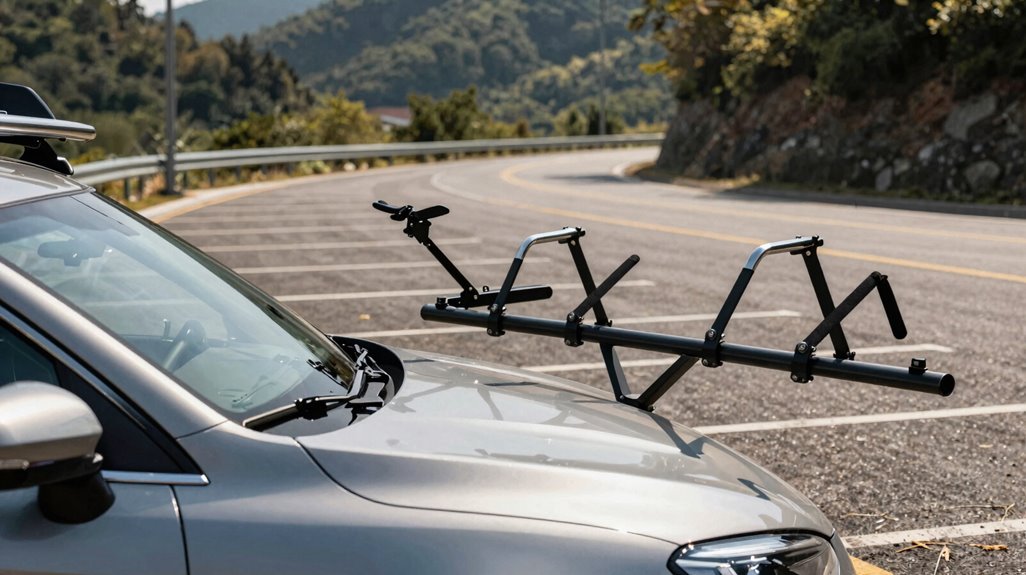
Where do I even begin when the market offers so many ways to haul my bike? I start with my vehicle, because nothing else matters if the rack won’t fit.
- Check Your Foundation. Before browsing roof racks, hitch-mounted racks, or trunk racks, I confirm vehicle compatibility using fit guides from Thule and Yakima. Does my car have cross bars? A hitch receiver? Without these, installation gets complicated.
- Know Your Measurements. Hitch receiver sizes, 1.25, 2.0, or 2.5 inches, determine which hitch-mounted racks I can use. Roof racks demand compatible towers, feet, and fit kits for secure attachment.
- Calculate the Load. I always check weight capacity against my vehicle’s limits and my bike’s heft. Bike loading should feel effortless, not precarious.
- Prioritize Security. Stability means peace of mind on every road.
Hitch-Mounted Bike Racks: Platform vs. Hanging Styles
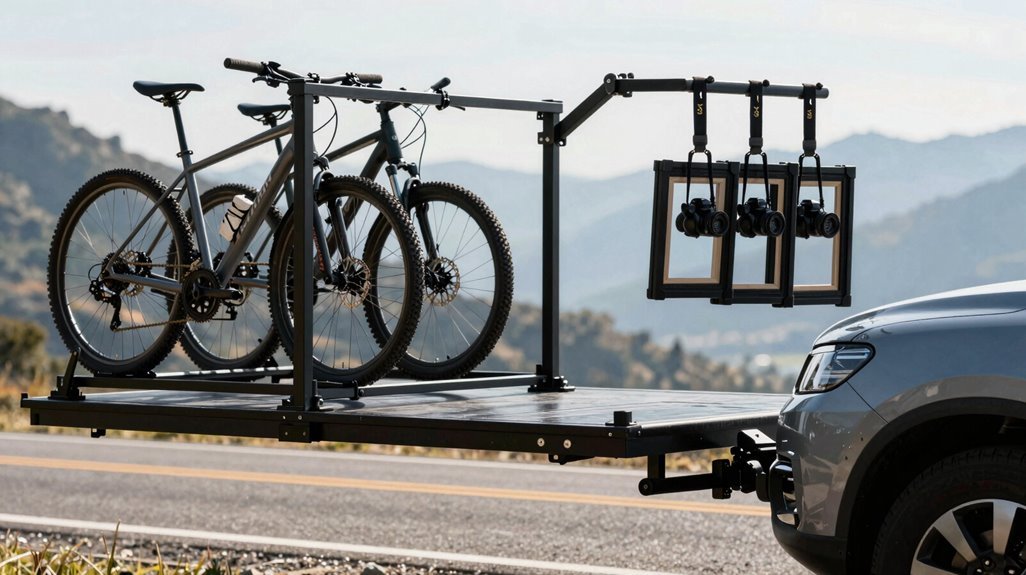
Once I’ve confirmed my vehicle’s hitch receiver, measuring that square aperture behind my bumper, typically 1.25 or 2.0 inches, I’m ready to choose between the two dominant architectural forms of hitch-mounted transport.
1. Platform Racks: The Foundation of Versatility
Platform racks cradle tires without frame contact, offering easy loading for heavy e-bikes and mountain rigs. Most require 2.0-inch receivers for adequate weight capacity. Many premium models feature tilt-away mechanisms, preserving rear access when loaded.
2. Hanging Racks: Streamlined Simplicity
Hanging racks suspend bikes from top tubes, sacrificing some bike security for lighter profiles. They’re compatible with 1.25-inch receivers but demand careful attention to frame contact and interference with tail lights.
Between these architectures, I’m weighing my garage’s inventory against my vehicle’s specifications, knowing the right choice connects me to trails waiting beyond every driveway.
Swing-Away Bike Racks: Keep Trunk Access With Heavy Loads

I’ve found that swing-away racks solve the eternal road-trip dilemma, needing your gear and your trunk space, by pivoting the entire load away from the vehicle with a simple release lever, even when I’m hauling two e-bikes pushing fifty pounds each. Unlike fixed hitch mounts that force you to unload everything for a roadside snack or tent retrieval, these systems preserve the architectural integrity of your cargo flow, letting me swing the platform a full ninety degrees while the hitch receiver bears the structural load.
When I’m selecting one, I prioritize models with 2-inch hitch compatibility and reinforced pivot points, knowing that ground clearance and arm strength become critical when the swing mechanism carries that much mass off-road.
Swing-Away Mechanism Benefits
Why should you sacrifice cargo access just because you’re hauling four bikes across three states? You shouldn’t, and that’s where swing-away engineering changes everything.
- Pivot Architecture: A swing-away bike rack rotates laterally on its mounting axis, creating rear-access clearance without unloading. This structural articulation, typically 90–180 degrees, preserves your vehicle’s functional envelope.
- Integrated Security: Most heavy-duty models incorporate a locking hitch pin with secondary cable systems, delivering theft deterrence at connection points and frame contact zones.
- Loading Ergonomics: Premium variants from RockyMounts and Kuat feature ramp aids for elevated mounting, accommodating 4–6 bike capacity with reduced physical strain.
- Compatibility Spectrum: These systems demonstrate broad hitch-class compatibility, though verifying receiver specifications remains essential before installation.
You’re joining a community that refuses compromise between adventure readiness and daily practicality.
Heavy Load Compatibility
How do you maintain rear cargo access when your swing-away rack’s loaded with 80-pound e-bikes and a week’s worth of gear? I’ve found the answer lies in choosing swing-away racks built for serious load distribution and bike stability.
1. Hitch Weight Capacity & Receiver Fit
Start with a 2-inch hitch; anything smaller compromises total load capacity. Heavy-duty swing-away racks like the RockyMounts AfterParty demand this foundation, supporting 200+ pounds across platform racks designed for heavy e-bikes.
2. Platform Architecture for Stability
Platform racks cradle frames directly, eliminating sway. This design ensures compatibility with large frames; think step-through e-bikes or fat-tire builds; that traditional mounts can’t handle.
3. Rear Clearance & Deployment
Swing mechanisms must clear tailgates fully. Verify rear clearance for lights and signals when deployed; some extensions, like Kuat’s Pivot v3, articulate smoothly even under maximum load.
Roof-Mounted Bike Racks: When Hitch Isn’t an Option
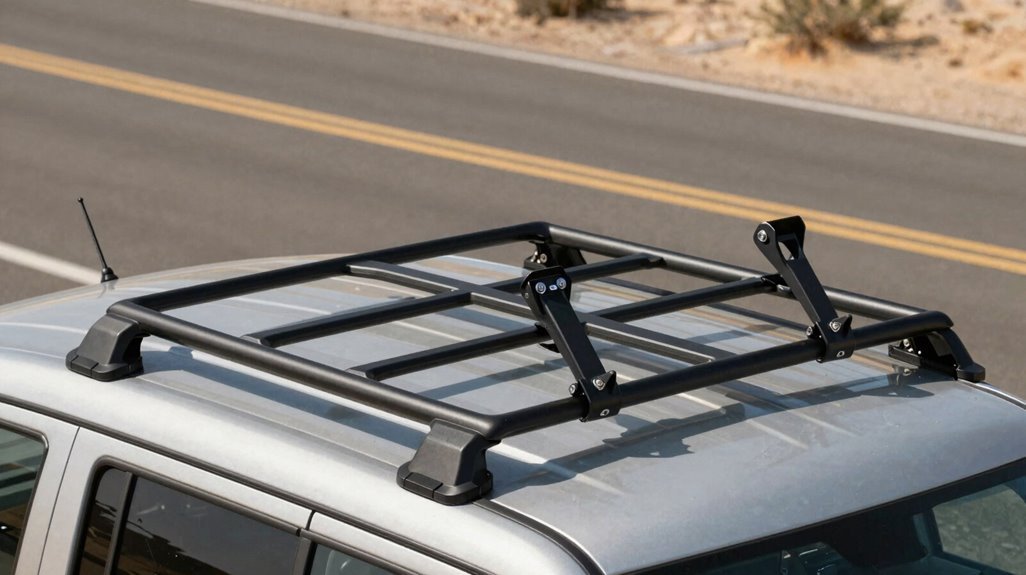
Not every vehicle arrives equipped for adventure—some lack the hitch receiver that makes hauling bikes effortless, leaving the roof as your primary structural canvas. I’ve found refuge in roof-mounted bike racks when my compact sedan needed to haul carbon frames without compromising vehicle access or ground clearance.
Here’s what drew me into this community of rooftop haulers:
- Fork-Mount Foundations — Securing bikes by the fork dropout creates aerodynamic efficiency, though you’ll master the art of wheel removal in parking lots from Portland to Patagonia; observational note: always stow that front wheel carefully.
- Upright Wheel-Mount Systems — Both wheels stay planted, ideal for wider tires and disc brake configurations, preserving frame integrity across long-haul drives through mountain corridors.
- Crossbar Architecture — Your roof rack demands compatible towers, feet, and fit kits anchored to these load-bearing beams; without proper crossbars, installation fails before it begins.
- Overhead Lifting Realities — Compatibility varies by rider height and roof elevation; factor this into your selection, especially when fatigue sets in after all-day rides in high-altitude terrain.
Trunk and Hatch-Mounted Bike Racks: No Rack System Required
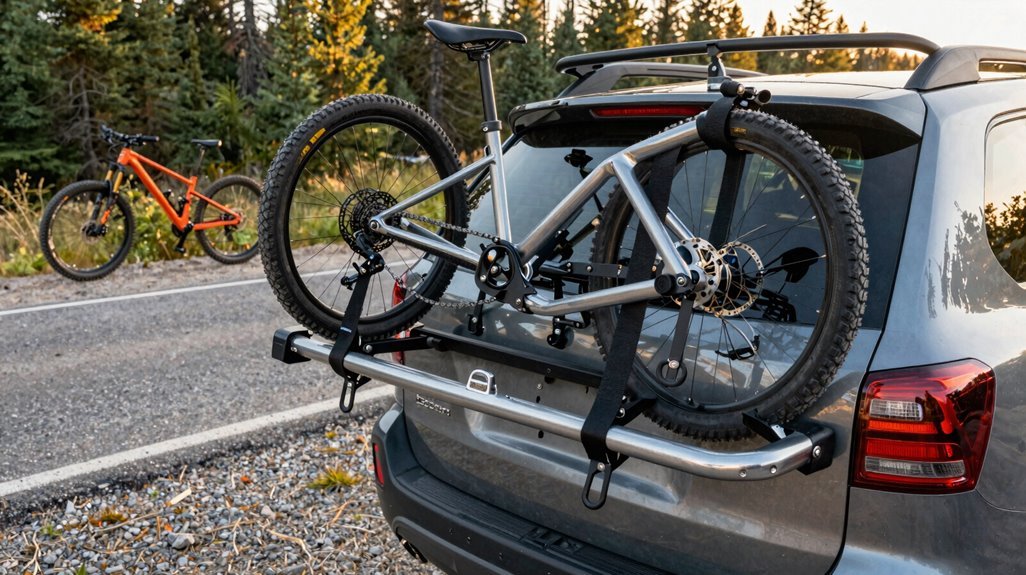
Where does one turn when the roofline sits too low for overhead lifting and the bumper remains bare of any hitch receiver? I find myself recommending trunk-mounted and hatch-mounted systems, architectural solutions that bypass structural modifications entirely.
These racks deploy straps and hooks to anchor against your vehicle’s rear profile, requiring zero permanent installation. I’ve loaded two bikes in under five minutes, though I always verify vehicle compatibility through manufacturer fit guides first.
The trade-offs emerge in daily use: rear access becomes compromised when bikes occupy the platform, demanding removal for cargo retrieval. Paint protection demands attention, unpadded contact points scar clearcoat. Security features vary widely; some models integrate locking cables, while basic configurations rely on strap integrity alone.
For drivers seeking belonging in cycling culture without garage modifications, this entry point delivers, provided you accept its spatial constraints.
Truck Bed Bike Racks: Protect Bikes in Your Pickup
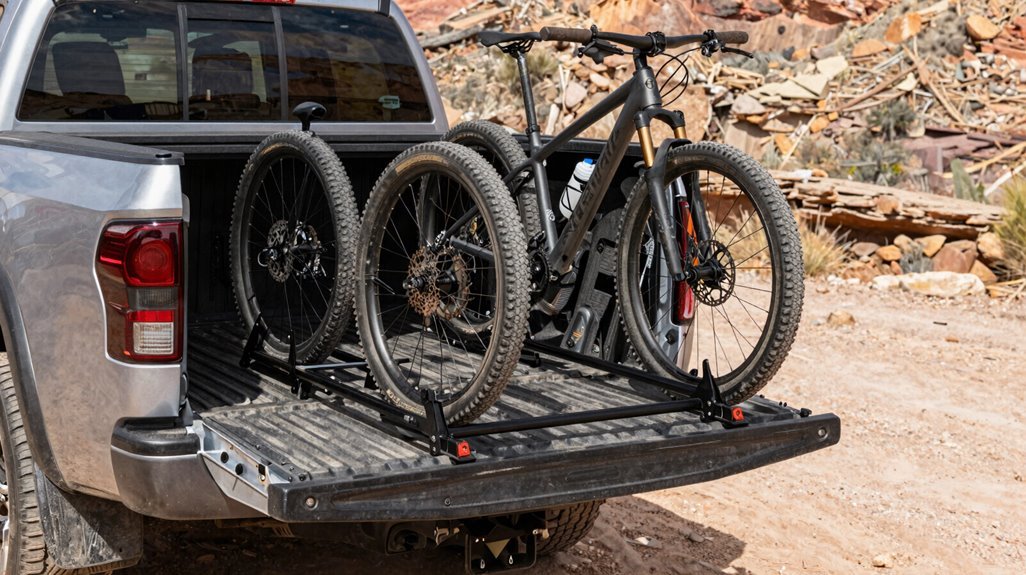
I anchor my bikes in the truck bed using either internal rail systems or support bars that clamp securely to the bed walls, with each mounting option offering distinct advantages for different payloads and pickup configurations.
Beyond securing the frame, I’m looking at racks with padded contact points and rubberized bed protection that prevent the finish from chipping when I’m hauling through construction zones or down rutted forest roads. These features matter because I’m not just transporting equipment; I’m preserving the structural integrity of both my bikes and my truck’s cargo architecture.
Mounting System Options
Truck bed bike racks anchor your bikes to internal rails or support bars, keeping the center of gravity low, eliminating roof-mounted wind drag, and preserving your rear sightlines.
Rail-Mounted Systems — Slide-in brackets attach to factory bed rails, providing a clean mounting system without drilling. This preserves your truck’s structural integrity.
Support Bar Frameworks — Elevated crossbars span the bed width, positioning bikes above wheel wells. Adjustable trays accommodate varying frame geometry.
E-Bike Configurations — Reinforced bed rack options with 70+ lb load capacity per bike, featuring heavy-duty hardware for e-bike compatibility.
Integrated Security — Leading models incorporate lockable hitch rack-style pins and braided security cables, protecting your investment during trailhead stops.
These mounting solutions maintain rear visibility while delivering versatility, joining fellow riders who’ve discovered bed rails outperform roof alternatives.
Bed Protection Features
Beyond securing your bikes to rails and crossbars, you’ll want to consider what happens when rubber meets metal, specifically, how your truck bed withstands the abrasion, pressure points, and environmental exposure that come with hauling expensive carbon fiber or aluminum frames. I’ve learned that proper bed protection separates weekend warriors from those replacing scratched liners annually.
| Protection Element | Function | Your Benefit |
|---|---|---|
| Bed-mounted rails | Distribute load across structural points | Preserves cargo space beneath bikes |
| Anti-sway cradles | Eliminate lateral movement | Maintains interior clearance for gear |
| Tie-down points | Anchor wheels at multiple positions | Ensures wheelbase fit across bike sizes |
| Weather-resistant pads | Shield against UV and moisture | Extends installation compatibility |
When evaluating truck bed bike racks, I prioritize systems integrating these features, knowing my community counts on gear that performs from Moab to Maine without compromise.
Spare-Tire Bike Racks: The Forgotten Alternative
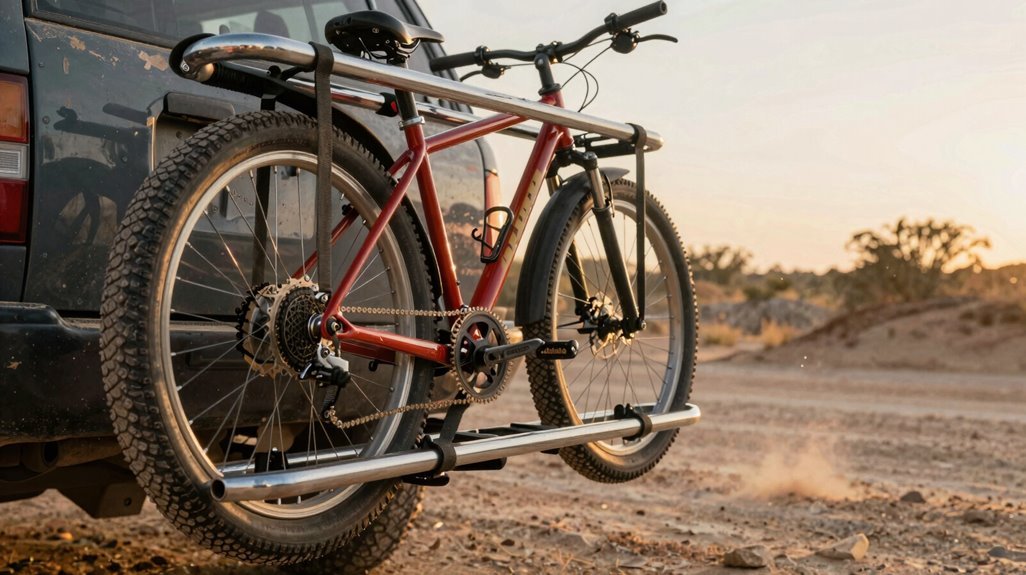
Where else could you mount a bike rack when your hitch is occupied and your roofline already carries a cargo box? I’ve found the spare-tire bike rack, an elegant, hitch-free solution hiding in plain sight.
- Mounting Architecture: This rear-mounted system anchors to your vehicle’s spare tire carrier, preserving structural integrity while keeping cargo space intact.
- Security Framework: Wheel mounting trays and frame hooks accommodate diverse geometries, securing bicycles through adjustable lever mechanisms.
- Spatial Considerations: You’ll need to monitor rear clearance during navigation, plus address potential tail lights and license plate obstruction with auxiliary lighting kits.
- Investment Value: Remarkably budget-friendly, though vehicle compatibility demands careful measurement; spare tire diameter and bolt patterns vary across manufacturers.
Before committing, consult fit guides; this forgotten alternative rewards thorough planning with uncompromised accessibility.