Building a backyard sanctuary isn’t always kind to the wallet, I’ve learned that much staring at quotes that feel more like mortgage payments than garden storage. Whether you’re housing tools or crafting a studio, the numbers shift dramatically based on what you can’t see beneath the floorboards.
Let me show you where your money actually goes.
What Sheds Cost in 2026: From $1,500 DIY Kits to $8,250 Custom Builds

Wondering what you’ll actually pay to build a backyard shed in 2026? I’ve researched the numbers so you can plan with confidence, whether you’re crafting a weekend retreat or practical storage.
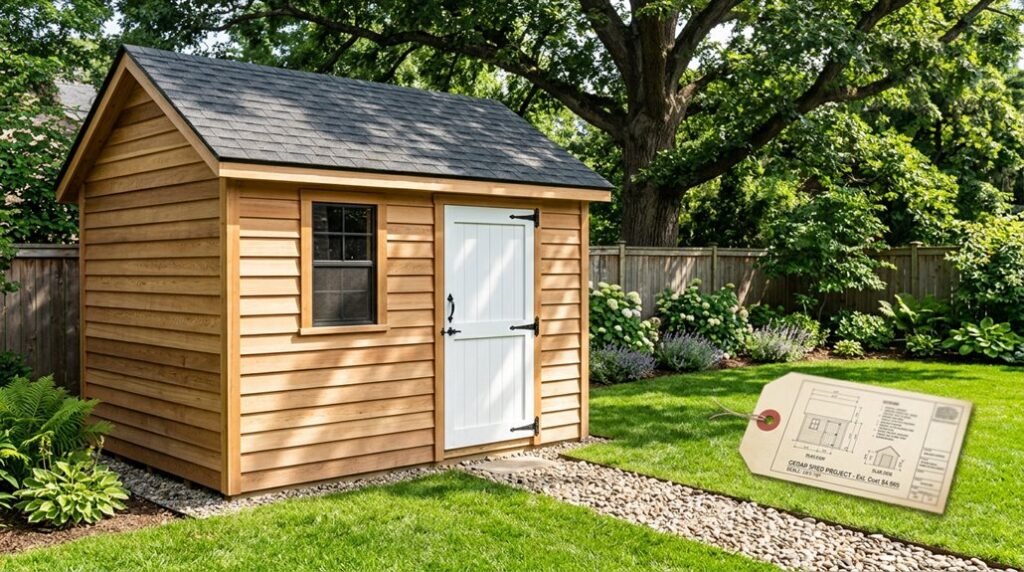
Shed costs span wide territory. Professional builds average $3,350 nationally, ranging $1,875–$8,250 depending on scope. Going solo? DIY shed kit projects run $3,000–$6,000, with bare materials starting near $1,500.
Your foundation choice matters enormously. A gravel pad costs $1–$2 per square foot, while a concrete slab demands $6–$12, delivering superior durability for permanent structures.
Professional labor costs ($50–$100/hour) push budgets higher, though prefab kits balance speed against customization. Don’t overlook permitting ($50–$500), varying wildly by municipality.
Understanding these variables lets you build smart, and join the community of homeowners who’ve turned their backyards into functional, beautiful spaces.
Shed Cost Per Square Foot: How Size and Design Change Your Total

Why does a 200-square-foot shed sometimes cost more per foot than one twice its size? I’ve learned that size economies reshape everything we assume about building. Here is how cost per square foot shifts:
1. Base Costs Hit Harder Small. Fixed expenses, permits, design, site access, spread across fewer square feet, inflating your per square foot rate dramatically. A compact footprint cannot absorb these overheads efficiently.
2. Prefab Shed Kits Change Math. Opting for a prefab shed kit typically lowers your total investment, though assembly runs $10–$20 per square foot extra. You’re trading customization for predictability; worth it when timelines matter.
3. Foundation Scales Unevenly. Gravel pads ($1–$2 per square foot) suit modest structures; concrete slabs ($10–$12 per square foot) anchor larger builds. Foundation choices compound with size, reshaping materials costs in unexpected ways.
Shed Building Materials Ranked by Price and Lifespan
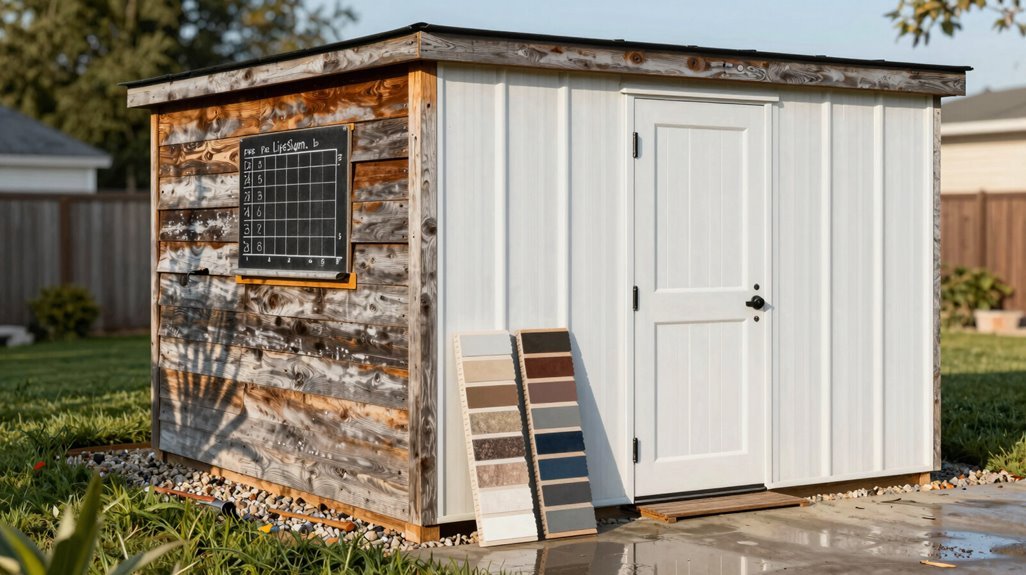
How do you choose between a shed that lasts a decade and one that stands for generations? I’ve broken down the options so you can find your place in the spectrum of durability and investment.
- Vinyl: The Practical Starter. With material costs running $200–$5,000 and siding at $3–$7/ft², vinyl offers low maintenance and modest lifespan. Its lightweight foundation and installation requirements suit suburban lots where simplicity matters.
- Metal: The Value Workhorse. At $500–$700, metal delivers the cheapest long-term ownership. Siding runs $6–$16/ft²; minimal foundation needs keep installation requirements straightforward.
- Wood: The Classic Compromise. Material costs hit $3,000–$15,000 with siding at $5–$15/ft². You’ll trade ongoing maintenance for timeless aesthetics and moderate lifespan.
- Brick: The Legacy Build. $3,200–$30,000 buys permanence. Substantial foundation and installation requirements reflect its structural integrity, an heirloom for your property’s future.
Hidden Costs to Build a Shed: Foundation, Site Prep, and Labor

Where exactly does your budget disappear when that simple backyard structure balloons from a $2,000 kit to a $15,000 project? I’ve watched too many homeowners get blindsided by what lies beneath, literally.
1. Foundation: The Hidden Anchor
Your gravel pad runs $1–$2 per square foot, budget-friendly, permeable, perfect for drainage. But I’m seeing more neighbors opt for a concrete slab at $10–$12 per square foot, craving that permanent, frost-resistant base for heavy equipment.
2. Site Prep: Clearing What You Can’t See
Grading and clearing add roughly $1 per square foot, though rugged terrain, think rocky New England slopes or overgrown Pacific Northwest lots, can spike costs to $1,266–$3,900.
3. Labor: Skilled Hands, Measured Hours
Contractors charge $50–$100 hourly; prefab assemblies tack on $10–$20 per square foot. You’re paying for precision, speed, and the peace of mind that comes with professional craftsmanship.
DIY Build vs. Prefab Kit vs. Custom Pro Install: Which Saves More?

When you’re staring at that empty corner of your yard, the math isn’t as simple as it first appears; I’ve run the numbers three ways, and each path carries its own ledger of trade-offs.
| Approach | Cost Range | Time & Trade-offs |
|---|---|---|
| DIY build | $1,500–$4,000+ | 20–50 hours; 40–50% cost savings on materials and labor, plus $200–$800 for tools |
| Prefab kit | $2,500–$5,500 | Faster assembly; less customization, balanced durability |
| Custom pro install | $4,000–$10,000+ | Zero sweat equity; premium pricing for bespoke design |
I’m drawn to the DIY build for the sheer satisfaction of raising every stud myself, though I’ve learned to budget for delivery fees and rental gear. The prefab kit tempts me when weekends shrink; it’s the middle path our community of weekend makers often debates. Custom pro install? That’s for when craftsmanship outweighs cost savings entirely.
How to Lower Your Shed Build Cost Without Regrets

I’ve trimmed thousands off my own builds by focusing on three levers: smart material choices, DIY labor savings, and strategic size selection. Each carries distinct trade-offs between upfront savings and long-term satisfaction.
Balancing vinyl siding at $3–$7 per square foot against wood’s aesthetic warmth, weighing gravel pads ($1–$2 per square foot) against concrete’s permanence, and knowing when prefab kits outpace pure DIY for speed without sacrificing too much budget flexibility, these decisions shape whether you’ll celebrate your savings or curse shortcuts later.
Keeping the footprint modest (reducing both framing costs at $12–$25 per square foot and foundation requirements) while designing for future electrical upgrades ($500–$2,000) creates a structure that scales with your needs rather than boxing you in.
Smart Material Choices
Why sacrifice quality when strategic selections can trim thousands from your final bill? I’ve learned that smart material choices transform budget constraints into architectural opportunities.
1. Siding That Pays Back
Vinyl siding costs run $3–$7 per square foot, far below wood’s $5–$15 or metal’s $6–$16, delivering durability without the premium. You’ll belong among savvy builders who prioritize longevity over fleeting trends.
2. Prefab Efficiency
Prefab shed kits compress material prices and labor into one streamlined package, with professional assembly adding merely $10–$20 per square foot post-delivery.
3. Foundation Flexibility
Evaluating foundation options, I chose gravel at $1–$2 per square foot, saving substantially against concrete’s $10–$12, without compromising structural integrity.
4. Framing Fundamentals
Managing framing costs between $11–$30 per square foot means selecting standard lumber dimensions, avoiding custom cuts that inflate budgets unnecessarily.
DIY Labor Savings
Material decisions set the stage, but your own hands open the deepest savings. DIY labor savings can slash your shed cost by 40–50% compared to hiring out, a difference that often determines whether your backyard vision becomes reality.
- Understanding the math. Labor rates for contractors run $50–$100 per hour, meaning a typical 10×12 build requiring 20–50 hours quickly escalates. When weighing DIY vs professional, remember: every hour you invest returns directly to your pocket.
- Prefab shed kits as middle ground. These speed up assembly, sometimes cutting time in half, but delivery fees and limited customization persist. They’re practical when your budget exceeds $2,500 and precision matters more than personalization.
- The threshold decision. Below $2,500, DIY isn’t merely economical, it’s essential for medium-sized structures. Your sweat equity turns constraint into craftsmanship.
Strategic Size Selection
How do I shrink the budget without shrinking my dreams? I’ve learned that strategic size selection lets me build smart, not small-minded.
- Target 120 sq ft or less. At this size, I’m minimizing total outlay while keeping cost per square foot manageable; framing runs $12–$30 per sq ft here, and every choice matters more.
- Compare foundation costs ruthlessly. A gravel pad ($1–$2 per sq ft) versus concrete ($10–$12 per sq ft) means my size decision directly controls site prep expenses.
- Leverage prefab kits for efficiency. These cut labor 40–50%, making compact builds attainable without custom price tags.
- Embrace the DIY shed path. Smaller footprints mean simpler construction; I’m not compromising quality, just eliminating excess.