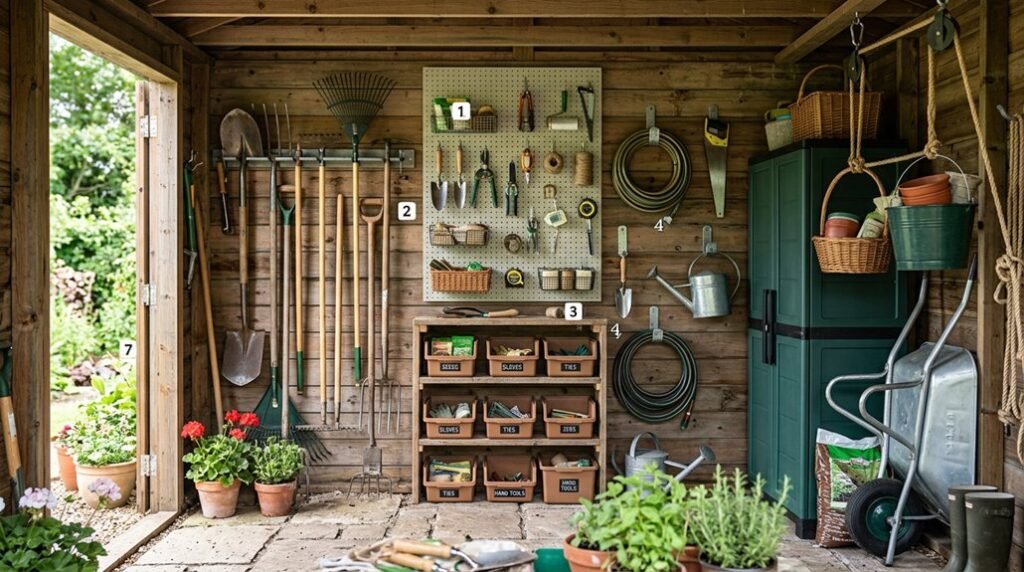
Most gardeners lose 30% of usable growing season to tool-related inefficiencies: time spent searching, repairing weather damage, or tripping over scattered equipment. I’ve spent years refining outdoor storage systems across four climate zones, from humid Gulf Coast summers to freeze-thaw cycles in the upper Midwest.
What follows isn’t theoretical. These seven solutions balance architectural durability with genuine practicality, each tested against real conditions. You’ll want to see which ones survive where you live.
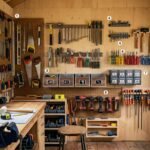
Install a Wall Rack System to Free Up Floor Space
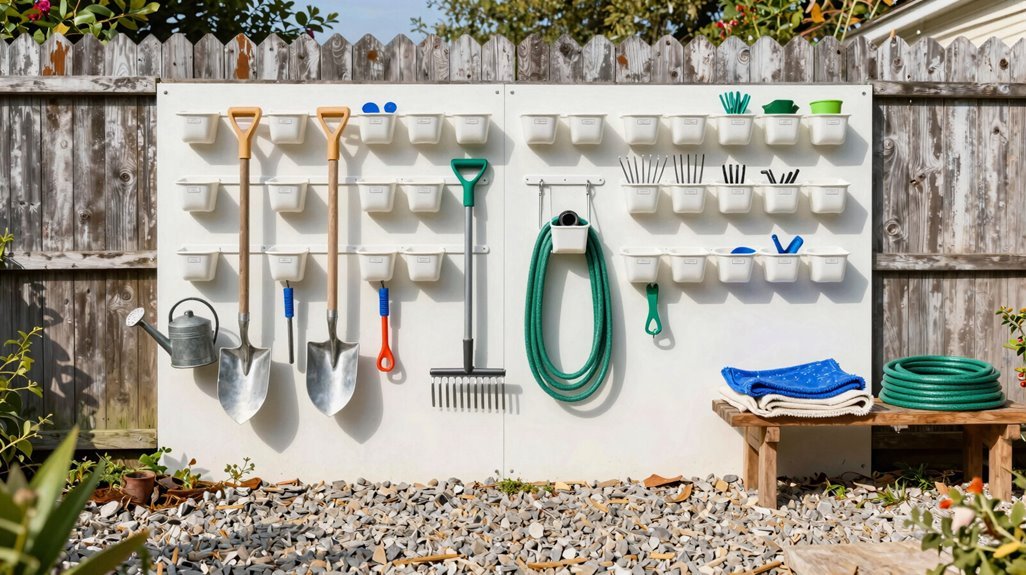
Where does your garden gear disappear when you need it most? I’ve found that installing a wall-mounted rack changes chaotic sheds into functional spaces, keeping floor space free for actual work.
A wall-mounted rack transforms chaotic sheds into functional spaces, keeping floor space free for actual work.
1. Choose Your System
Rubbermaid FastTrack and StoreYourBoard BLAT anchor securely to studs, supporting 50-250 pounds. I mount mine at eye level: tools visible, accessible, protected from ground moisture.
2. Maximize Density
Proslat Slatwall offers 75 pounds per square foot through customizable slat configurations. I’m stacking rakes vertically, hanging shovels horizontally. Every square inch serves tool storage purposes without visual clutter.
3. Plan for Expansion
Starter sets grow organically. I began with rails and hooks, later adding hose brackets and bucket clips. My wall-mounted rack evolves alongside my garden’s demands.
4. Specify Exterior-Grade Hardware
Corrosion-resistant mounting prevents system failure. I’m selecting powder-coated rails and stainless fasteners, ensuring structural integrity through freeze-thaw cycles and humidity.
Build a PVC Tool Holder for Under $10
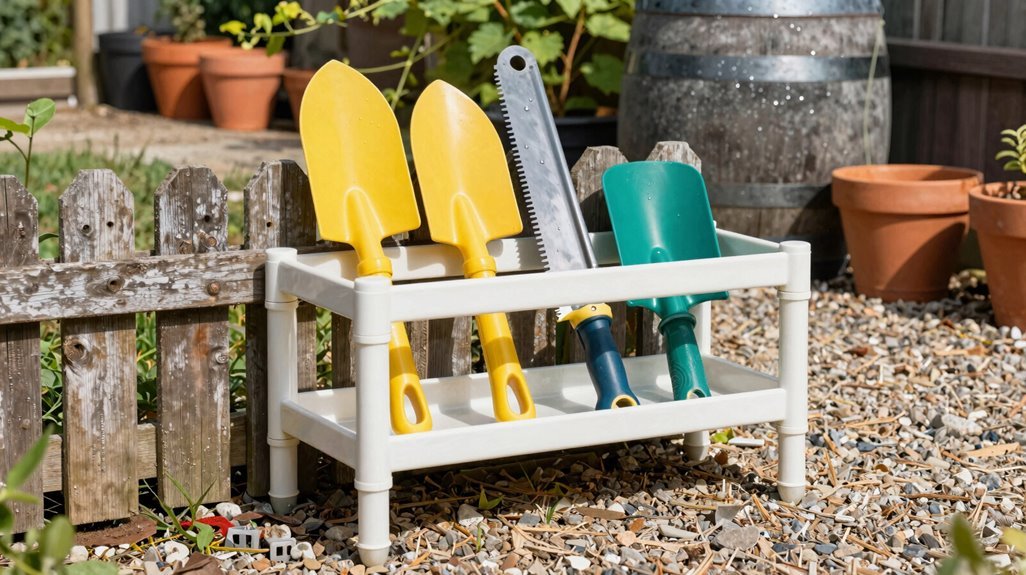
Why spend a fortune on commercial storage when a scrap of lumber and leftover pipe’ll transform your wall into an architectural-grade tool station? I’ve built this PVC Tool Holder for under $10, and it’s changed how my shed stays organized.
- Cut the Notch, Slice a 1-1/4-inch wide notch into 2-inch PVC pipe, creating the foundation for your vertical storage array.
- Drill the Slots, Bore several 3-1/2-inch-long, 1/8-inch-wide holes behind that notch; each aperture becomes a dedicated tool slot, keeping handles visible and accessible.
- Mount Securely, Screw the 2×4 backing to your wall with 1-1/4-inch drywall screws, then attach your PVC rack; slip garden tools through, achieving compact, weather-resistant organization that’d cost triple at retail.
Add a Wheeled Cart for Portable Garden Tool Access
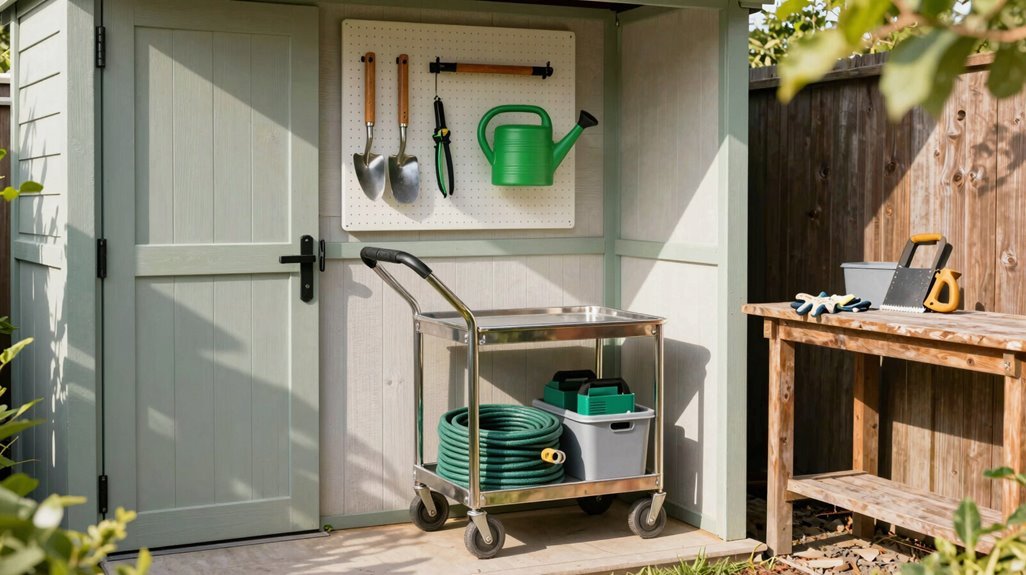
I’ve found that a sturdy wheeled cart changes how I move through my garden, rolling past raised beds and gravel paths without hauling heavy loads by hand. With steel-core construction, four-wheel stability, and weather-resistant finishes, these portable units carry long-handled tools and small accessories in onboard compartments, keeping everything within arm’s reach.
Pairing one with a wall-mounted organizer creates a layered system: mobility where I need it, structure where I don’t.
Portable Mobility Benefits
How often do you find yourself trekking back and forth across your property, shovel in one hand, pruners in another, wasting energy that could go toward the actual work? I discovered wheeled tool storage changes this grind into seamless productivity, granting mobility that carries long-handled tools and hand implements in a single, efficient journey.
Consider these portable solutions reshaping how we garden together:
- Freestanding Racks — Units like the Suncast Wheeled Tool Storage Rack accommodate dozens of implements, rolling steadily across turf or gravel to your beds; no more scattered piles, no more forgotten trowels.
- Bucket-Based Caddies — The Mobile Tool Storage Caddy pairs outdoor-rated casters with familiar 5-gallon architecture, shuttling essentials between vegetable plots and perennial borders without exhausting repetition.
- Ergonomic Transport — Wheel-equipped systems eliminate back strain through one-trip logistics, preserving stamina for cultivation itself.
Prioritize weight capacity, terrain stability, and long-handled tool compatibility when selecting your rolling companion.
Tool Organization Features
Where does the chaos end when every tool demands its own trip across the garden? I’ve found my answer in strategic tool organization, specifically, a wheeled cart that turns scattered equipment into a mobile workstation.
When selecting your cart, prioritize these architectural elements:
1. Structural Integrity for Heavy Loads
Seek steel-cored frames with four-wheel stability, navigating uneven flagstone paths and loamy beds without tipping; your long-handled implements deserve secure transport.
2. Integrated Storage Systems
Drawers, trays, and dedicated tool holders eliminate rummaging; everything finds its designated niche, from pruners to trowels, creating that satisfying spatial order we crave.
3. Weatherproof Storage Compartments
Sealed compartments with protective coatings withstand morning dew and seasonal downpours, preserving your investment through climate fluctuations.
4. Ergonomic Ground-Level Access
Make sure dimensions accommodate your complete assortment—rakes, shovels, hoses—at accessible heights, minimizing repetitive bending during intensive planting sessions.
Weather Resistance Options
When the afternoon storm rolls in unannounced, you’ll want more than hope protecting your investment; weather-resistant storage isn’t a luxury, it’s architectural necessity. I’ve learned that durable outdoor storage changes how we inhabit our gardens.
Here’s what actually withstands the elements:
- Resin Sheds — Vertical cabinets like Suncast’s 72-inch tower and Keter’s 150-gallon deck box deliver weatherproof tools protection against rain and UV degradation, their polyethylene construction refusing to warp or rot.
- Wheeled Mobility — Pairing fixed storage with portable carts, think Suncast’s rolling rack, creates flexible systems, letting me transport implements across the property without exposure risks.
- Elevated Mounting — Wall systems such as Proslat (75 lbs/sq ft capacity) and Rubbermaid FastTrack keep equipment suspended, eliminating ground moisture damage while maximizing spatial efficiency.
This layered approach, stationary weatherproofing plus portable accessibility, respects both permanence and practicality.
Stash Small Tools in a 5-Gallon Bucket Caddy
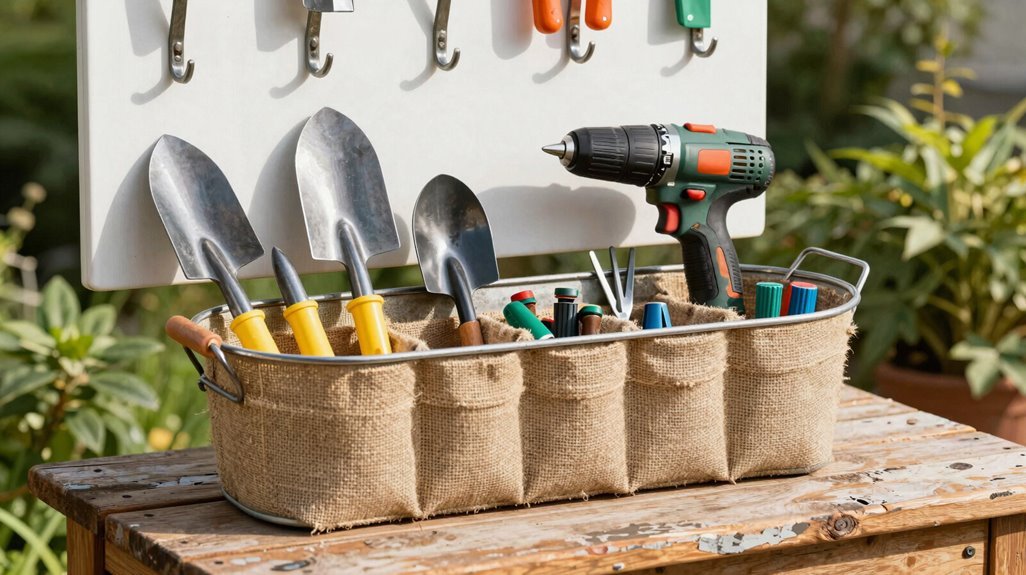
Why let trowels and pruners clutter your potting bench when a single, circular solution can corral them all? I use the Fiskars Garden Tool Bucket Bucket Caddy, a canvas organizer wrapping nine deep pockets around a standard 5-gallon bucket, for seamless organization of my small tools.
| Feature | Benefit |
|---|---|
| Nine deep pockets | Secures trowels, cultivators, pruning shears |
| Two pencil pockets | Keeps markers and labels accessible |
| Canvas construction | Lightweight, durable, weather-resistant |
| Sub-$20 price | Budget-friendly entry point |
The Bucket Caddy uses the bucket’s sturdy base and handle for portable transport across beds and borders. I stack mine with compatible organizers in the series, creating a modular system. This circular architecture, practical, unpretentious, democratic, belongs in every gardener’s toolkit.
Hide Outdoor Tools in a Weatherproof Mailbox Station
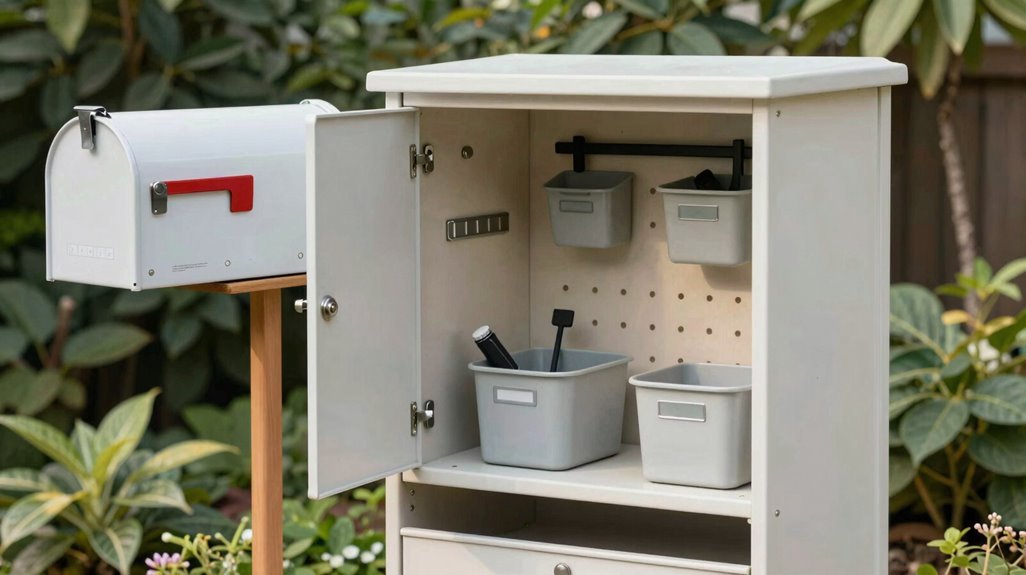
Not every gardener has room for a shed, or even a bucket system; sometimes, the most elegant solutions hide in plain sight. I’ve found that a weatherproof mailbox works well as tool storage, tucking gardening tools behind shrubbery where they’re accessible yet invisible.
The most elegant garden solutions hide in plain sight—like a weatherproof mailbox tucked behind shrubbery, keeping tools accessible yet invisible.
- Mount strategically: Position your weatherproof mailbox near perennial beds or vegetable rows, securing it to a pressure-treated post with stainless steel hardware for stability through freeze-thaw cycles.
- Seal thoroughly: Apply closed-cell foam gaskets and a drip-edge lid to prevent moisture intrusion, protecting pruners and trowels from corrosion in coastal or humid climates.
- Organize intentionally: Install PVC pipe segments or magnetic strips to create dedicated zones for gloves, hand rakes, and cultivators, eliminating rummaging during critical planting windows.
This compact system delivers architectural efficiency without dominating your landscape’s visual rhythm.
Hang Bulky Garden Gear on Stud-Mounted Hooks
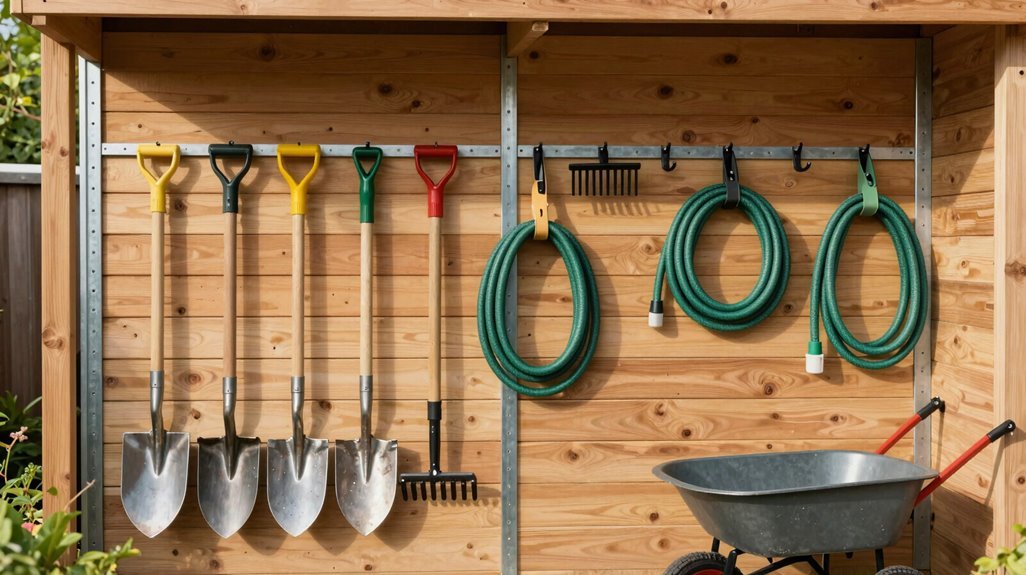
Three stud-mounted hooks transformed my cluttered garage wall into an architectural storage system, each steel bracket anchored through drywall into 2×4 framing, supporting 75-pound loads without flex.
I’ve learned that effective tool organization demands strategic placement. Staggering wall-mounted hooks at varying heights creates intuitive reach zones while preventing dangerous clustering at eye level.
Here’s my installation approach:
1. Select Heavy-Duty Hardware
Steel hooks withstand substantial torque from long-handled implements. I chose powder-coated brackets rated for 75 pounds minimum, no sagging, no pull-out, no regret.
2. Map Your Stud Layout
Using a stud finder, I marked 16-inch centers, then sketched tool silhouettes to determine optimal spacing. Shovels demand 8-inch clearance; rakes require angled positioning.
3. Vary Hook Profiles
Combining J-hooks, double prongs, and looped brackets accommodates diverse equipment, from pruning shears to extension ladders, within one cohesive system.
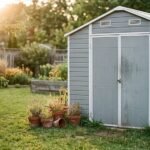
Buy a Vertical Shed for All-Weather Tool Protection
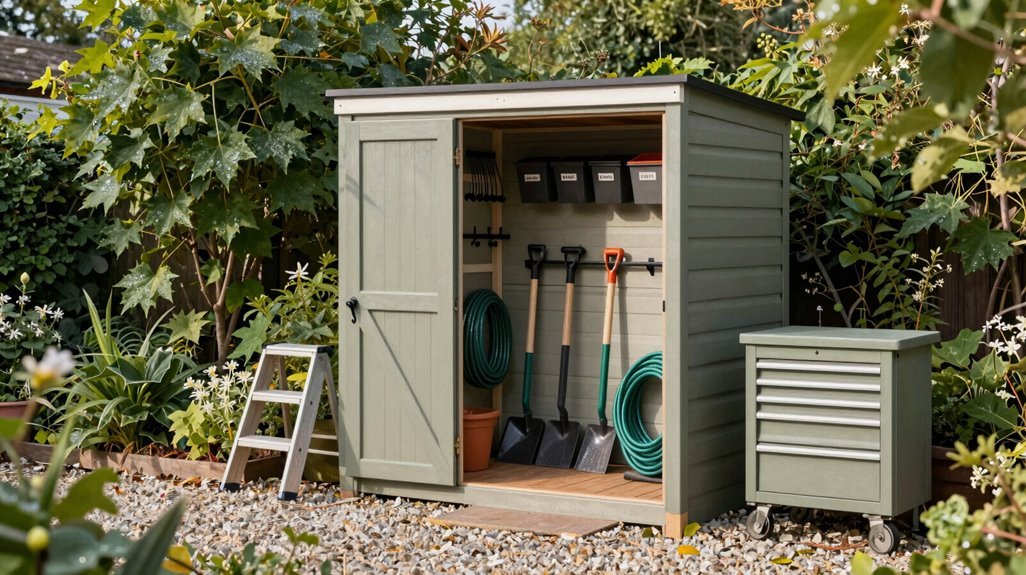
When wall-mounted solutions reach their limit, I’ve found that introducing a dedicated structure, vertical, freestanding, and weather-sealed, reclaims ground space while shielding my investment from the elements. A vertical shed transforms cramped patios into efficient tool storage zones, marrying cabinet utility with shed capacity in a slender footprint, roughly 72 inches tall by 32 inches wide.
For our community of garden enthusiasts seeking all-weather protection, I’ve identified three essentials:
- Prioritize resin construction, it resists UV degradation and moisture infiltration, extending tool life through brutal summers and freezing winters; I’ve watched neighbors replace wooden cabinets while mine endure, here in the Pacific Northwest.
- Demand lockable access, securing expensive implements brings peace of mind, especially in shared urban gardens or suburban plots near alleyways.
- Verify easy assembly, built-in handles simplify repositioning as your landscape evolves, accommodating shifting light patterns or expanded perennial beds.
Choosing wisely means joining fellow gardeners who’ve solved the weather-storage puzzle.