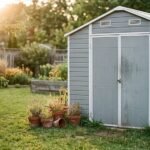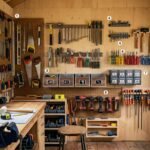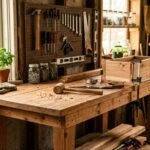

Standing in my backyard with muddy boots and a tape measure, I’ve helped neighbors install both resin and wood sheds across three states, and I’ve watched each choice age very differently. You’re about to make a $1,500–$5,000 decision that’ll sit on your property for fifteen years or more, yet most buyers compare these materials on price alone. That mistake costs people.
In the ten comparisons ahead, spanning assembly time, load capacity, HOA restrictions, and thermal performance, I’ll show you exactly which shed type aligns with your specific situation, whether you’re storing a zero-turn mower outside Raleigh or building a conditioned workshop in Montana’s zone 6A.
Resin or Wood Shed: Which Material Fits Your Needs?

Where do you begin when choosing between resin and wood? I’ve walked this path, comparing resin sheds against wood sheds, weighing what truly matters for your space. Let’s find where you belong.
Ease of Assembly. Resin sheds arrive lightweight; I snap panels together in hours, not weekends. Wood sheds demand carpentry patience, rewarding hands-on craftsmanship with bespoke results. *Observation:* Resin suits renters; wood appeals to permanence-seekers. (Suburban Ohio)
Customization Potential. I customize wood sheds endlessly, adding lofts, windows, french doors. Resin offers built-in shelves, yet limits structural dreams. *Observation:* Your workshop vision determines material loyalty. (Pacific Northwest)
Durability Under Load. Wood sheds bear heavy shelving without complaint; resin requires anchoring, carrying lighter wall loads. *Observation:* Storage density favors timber framing. (New England)
Lifespan Reality. I see well-built wood structures spanning 20–30 years against resin’s 5–7 year practical span; maintenance versus replacement math.
Which Shed Handles Weather and Moisture Better?

How do you protect what you store when the skies open and humidity climbs? I’ve found that resin sheds deliver superior moisture resistance right out of the box: no sealing, no staining, no rot to worry about. Their synthetic composition laughs off rain, snow, and sweltering summers alike.
Wood sheds? Beautiful, yes, but demanding. Without vigilant maintenance in wet climates, moisture penetrates, warping boards and inviting decay. I’ve seen untreated timber crack under relentless sun, its weather durability compromised without protective coatings.
Resin sheds often include UV inhibitors and built-in ventilation, preserving your gear through seasonal extremes. Wood offers customization potential: insulation, premium finishes, but requires investment to match resin’s inherent resilience.
Resin’s UV inhibitors and ventilation shield your gear effortlessly, while wood demands investment to achieve the same resilience.
For immediate, low-effort protection against the elements, resin prevails. For hands-on homeowners seeking tailored weatherproofing, wood rewards the effort.
What Maintenance Does Each Shed Type Really Need?
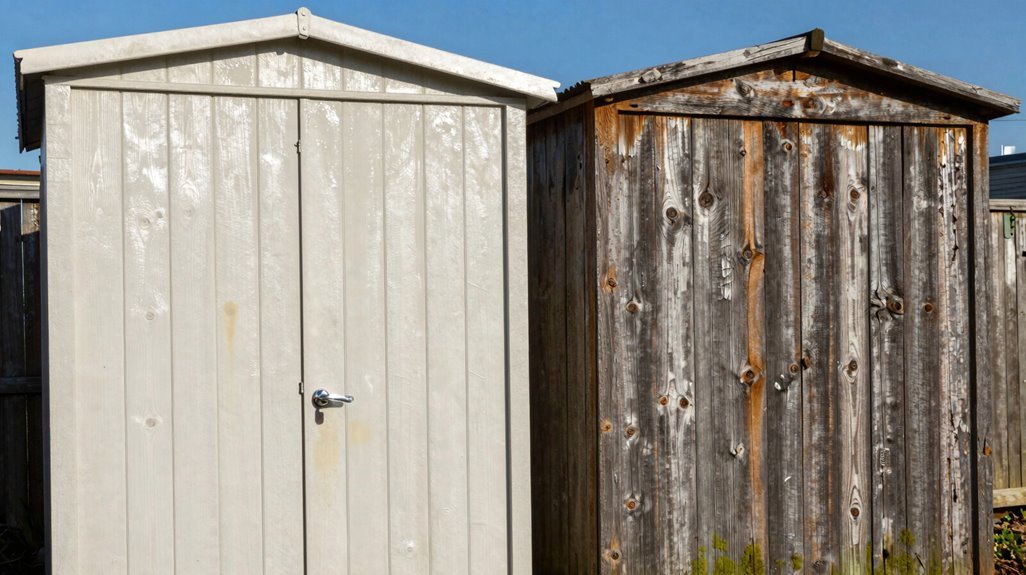
Looking at resin and wood side by side, you’ll find one demands almost nothing while the other asks for steady commitment. I’m breaking this down into two clear paths, showing you exactly what each material requires to stay standing strong. Here’s how resin shed maintenance compares to wood shed upkeep, from seasonal rituals to long-term care strategies.
Resin Shed Maintenance
Why settle for a structure that demands constant attention when you could invest your weekends in projects that actually excite you? Resin sheds maintenance fits the lifestyle you’re building, one that values presence over chores.
Here’s what maintaining your resin structure actually looks like:
Wash occasionally, worry rarely. A simple hose-down clears debris. No staining, sealing, or painting required; your moisture resistance handles humidity without swelling or rot, whether you’re coastal Carolinas or Pacific Northwest.
Anchor properly from day one. These lightweight panels, often under 300 pounds assembled, demand secure anchoring against wind uplift, particularly in Tornado Alley plains.
Mind the sun exposure. UV fading protection varies by manufacturer; premium brands integrate inhibitors preventing that chalky brittleness appearing after years of intense Arizona or Florida exposure.
Wood Shed Upkeep
While resin asks little of you, wood demands partnership, though I’m convinced the returns justify every hour invested in a structure that ages with intention rather than simply enduring.
- Staining & Sealing. I apply protective finishes every 3–5 years, creating rot resistance against rain and humidity: coastal Pacific Northwest, 36-inch annual rainfall. This preserves that warm, dimensional grain we gather around.
- Pest Vigilance. I inspect quarterly for termites and carpenter ants, treating localized infestations before they compromise structural members.
- Adaptable Repairs. Unlike resin’s panel replacement, I refinish or patch individual boards: shelving, lofts, ramps added incrementally. This extends lifespan 20–30+ years with engineered siding like LP SmartSide.
This upkeep, demanding yet rewarding, turns wood maintenance into craft. Your shed becomes legacy, not merely storage.
Can You Customize a Resin Shed Like a Wood Shed?
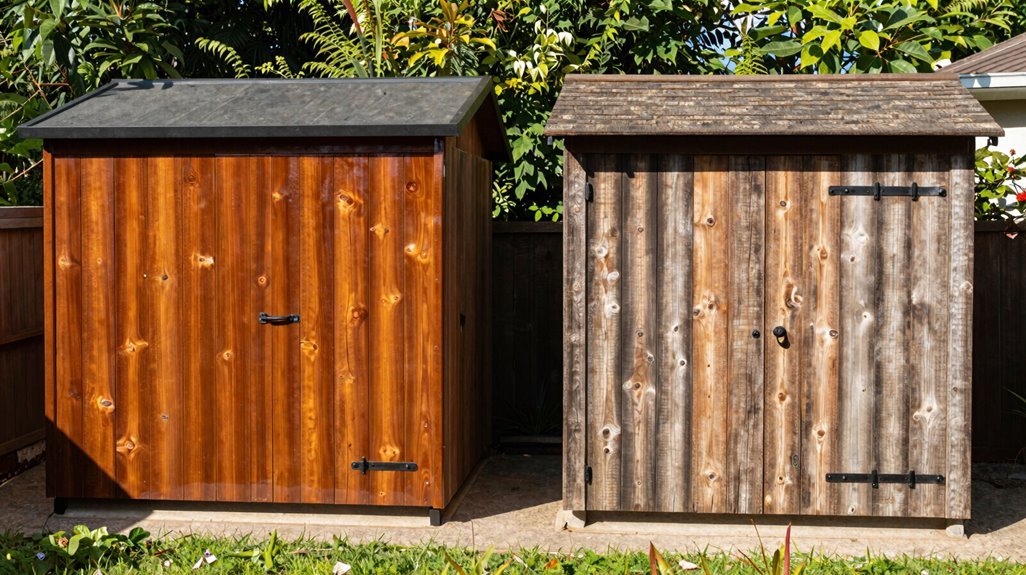
Just how much can you reshape a resin shed once it’s standing in your backyard? I’ve learned that customization separates these materials dramatically.
1. Structural Adaptability
Wood sheds welcome modification: adding lofts, heavy-duty shelving, custom windows, thanks to robust framing and treated lumber. With resin, you’re largely bound to factory-built racks and vents.
2. Interior Evolution
Wood supports insulation, wiring, and finish carpentry as your needs shift. Resin offers built-in practicality but resists reconfiguration.
3. Long-term Flexibility
Planning a workshop transformation or studio conversion? Wood accommodates ambitious upgrades. Resin maintains its original purpose, low-maintenance storage, without architectural elasticity.
For DIY enthusiasts building personalized sanctuaries, wood delivers belonging through creative control. Resin suits those prioritizing convenience over transformation.
Across neighborhoods, Portland’s maker spaces to Atlanta’s suburban lots, this distinction shapes backyard identity.
How Fast Can You Build Each Shed? (DIY vs. Pro)
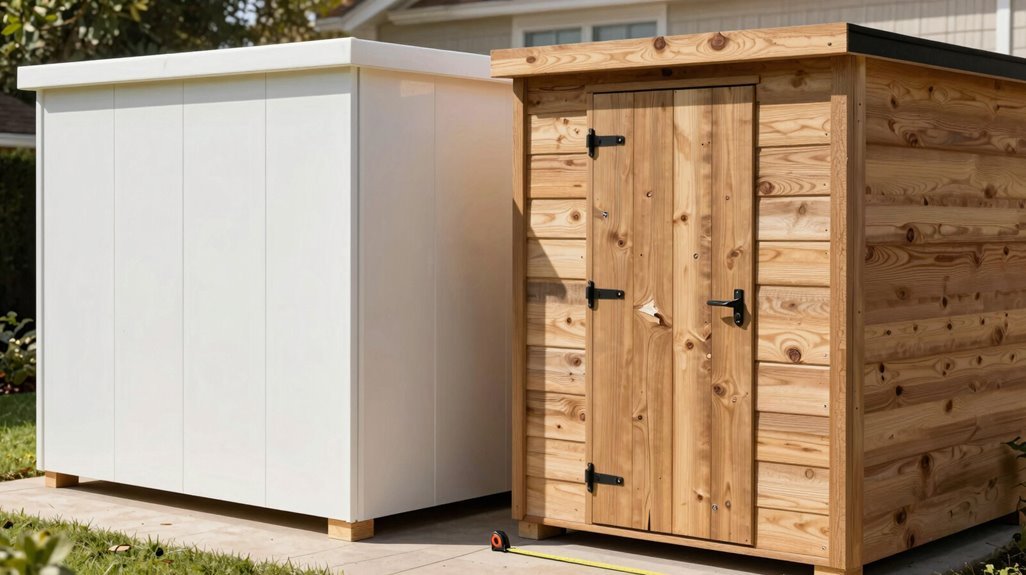
I’ve wrestled with weekend projects that stretched into weeks, so I know timing matters when you’re choosing between resin and wood. Resin sheds, snapping together like oversized LEGO sets, often go from box to backyard in a single afternoon, even for solo DIYers working with pre-drilled panels and minimal tools.
Wood construction demands more: cutting, leveling, and fastening a framed structure that rewards patience with decades of service, though hiring a pro crew can compress that timeline dramatically.
Assembly Time Comparison
The assembly timeline separates these two shed types more dramatically than almost any other factor; resin models arrive at your property as pre-engineered kits, their modular panels clicking together like oversized architectural Lego while integrated vents, shelving, and floor systems eliminate the need for separate component installation. You’ll find assembly time heavily favors resin sheds, with most DIYers finishing in 4-6 hours versus wood sheds demanding 2-4 days of framing, siding, and sealing work.
| Factor | Resin Sheds vs Wood Sheds |
|---|---|
| Typical DIY Time | 4-8 hours vs 2-4 days |
| Skill Level Required | Beginner vs Intermediate+ |
| Tool Requirements | Basic hand tools vs Circular saw, nail gun, level |
| Integrated Features | Pre-installed vs Custom-built on-site |
Wood sheds reward your patience with bespoke craftsmanship, but resin sheds welcome you into weekend-project territory; lighter components mean you’re organizing garden tools by Saturday evening, not Sunday sunset.
Professional Installation Speed
Across the industry, professional crews move through resin installations with assembly-line efficiency: most prefab kits translate to 2-4 hours of billed labor, whereas wood construction demands 1-3 days of skilled carpentry. When you’re weighing options, professional installation speed becomes a deciding factor in your project timeline.
Here’s what separates resin sheds from traditional builds:
- Panelized construction: interlocking resin components eliminate cutting, measuring, and complex joinery
- Foundation flexibility: resin kits install directly on level ground or gravel pads, skipping concrete curing time
- Tool minimization: cordless drills and rubber mallets replace circular saws, nail guns, and compressors
- Weather immunity: resin panels arrive sealed and finished, removing staining or painting delays
- Crew size efficiency: two technicians complete most resin installations; wood builds require larger teams
For homeowners seeking weekend completion without sacrificing quality, resin sheds deliver unmatched installation speed.
10-Year Cost Comparison: Which Shed Saves More Money?

Anyone weighing a shed purchase faces a pivotal question: how much will this actually cost me over time? When I examine resin vs wood costs, the numbers tell a compelling story.
Resin sheds demand minimal upkeep; no sealing, staining, or pest treatments, so maintenance costs stay negligible across a decade. Wooden sheds, while customizable, require ongoing preservation efforts that accumulate steadily.
Resin sheds need virtually no maintenance, while wood demands constant, costly care to survive the decade.
The longevity value of resin emerges through its weather resistance and rot-proof composition, eliminating replacement cycles. Wood offers adaptability, yet that flexibility carries recurring investment.
For budget-conscious homeowners seeking lasting shelter without perpetual expenditure, resin typically wins the 10-year equation. Your shed should serve you, not become a recurring expense draining resources better spent elsewhere.
How Long Do Resin and Wood Sheds Actually Last?
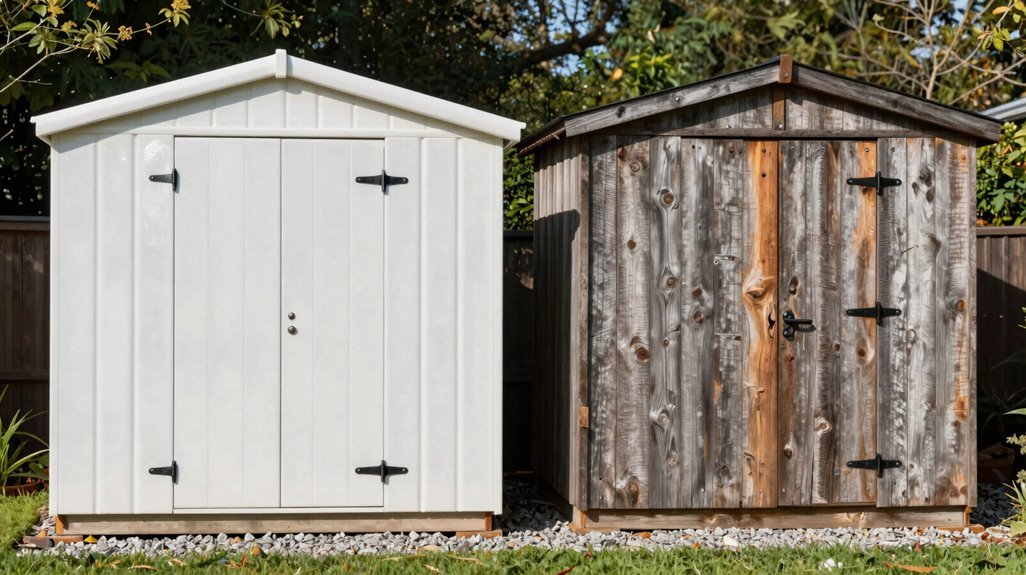
When I’m weighing a shed investment, I want hard numbers on longevity. Resin typically gives me 5–7 years before UV degradation and panel fatigue set in, while a well-built wood structure, framed with pressure-treated lumber and clad in engineered siding like LP SmartSide, can stand strong for 20–30 years with diligent maintenance.
Climate plays a decisive role here: my resin shed in Arizona’s relentless sun will deteriorate faster than one in mild Oregon, just as my wood shed in humid Florida demands more vigilant sealing than its counterpart in arid Colorado. Ultimately, I’m choosing between resin’s hands-off convenience with a shorter horizon and wood’s demanding care cycle that rewards me with decades of serviceable, repairable shelter.
Lifespan Expectations
How long should you realistically expect your shed investment to hold up against decades of weather, use, and changing needs? I’ve learned that lifespan isn’t just about materials, it’s about how we build, protect, and adapt our spaces over time.
- Wood longevity: Quality lumber framing delivers 20–30+ years of structural integrity when properly anchored and sealed
- Resin realities: Marketed durability often masks UV degradation, panels weaken, fade, and become brittle faster than expected
- Adaptability advantage: Wood evolves with your needs, accepting insulation, wiring, and interior finishes as your property grows
- Repair limitations: Cracked resin panels require full replacement, while wood components can be patched, sistered, or refinished
- Climate dependency: Coastal humidity, freeze-thaw cycles, and sun exposure dramatically alter actual durability regardless of material
Your shed’s true lifespan depends on construction quality, environmental protection, and maintenance commitment from day one.
Maintenance Impact
Although I’ve watched both materials weather seasons on my own property, I’m still struck by how maintenance demands ultimately shape what you actually get for your money.
Resin sheds promise 15–20+ years with minimal upkeep: no sealing, staining, or pest protocols required. You’ll simply anchor panels against wind shift and monitor UV degradation, which remains their primary longevity challenge.
Wooden sheds demand more: annual sealing, biennial staining, and vigilant rot prevention. Yet this maintenance investment yields 20–30+ years through repairable framing and upgradeable siding.
Consider your commitment level. Resin suits hands-off owners seeking predictable, shorter lifespans. Wood rewards those willing to nurture their structure, building equity through decades of refinements, additions, and personalized architectural evolution.
Your choice reflects which maintenance philosophy fits your lifestyle, not just your yard.
Climate Factors
Where you build matters as much as what you build. I’ve learned this watching sheds struggle or thrive across dramatically different landscapes.
Climate durability hinges on matching your structure to regional stressors. I’ve seen resin’s resilience to moisture shine in Florida humidity, while wood’s thermal mass handles Minnesota’s freeze-thaw cycles with grace.
Consider these climate realities:
- Resin panels flex in coastal gales, demanding robust anchoring systems
- Wood framing, properly engineered, spans 20–30 years with disciplined maintenance requirements
- Humid zones favor resin’s rot immunity over wood’s vulnerability
- Temperature swings test metal hardware in both materials
- UV exposure degrades resin surfaces gradually, requiring eventual replacement
Your local weather patterns aren’t obstacles; they’re design parameters. Choose accordingly, and your shed becomes a lasting extension of your property’s character.
Do Resin or Wood Sheds Resist Pests and Rot Better?
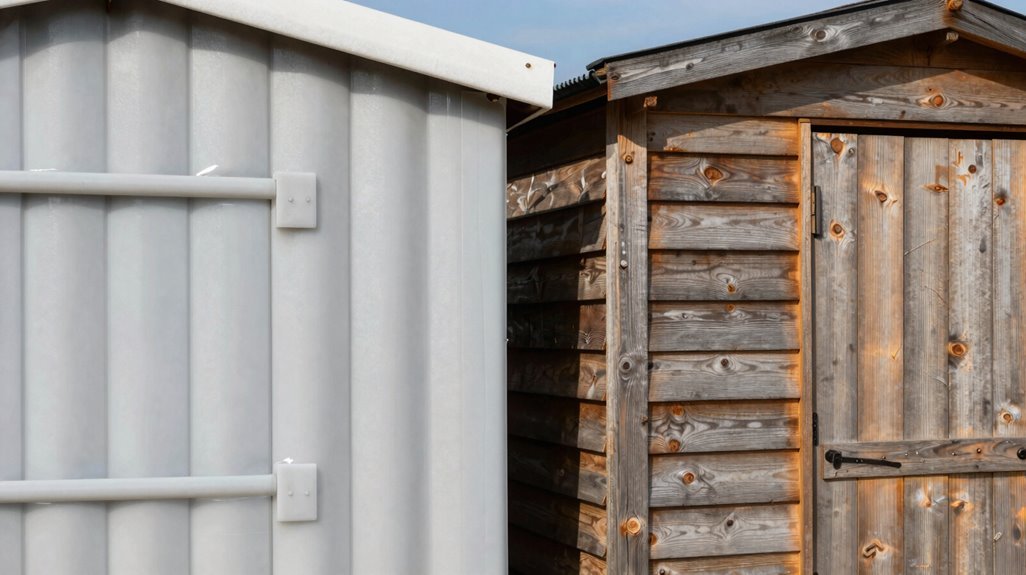
When I’m weighing storage solutions for my backyard, pest and rot resistance inevitably surface as make-or-break factors, particularly in humid climates where moisture wages constant war on organic materials.
Resin Sheds Deliver Superior Rot Resistance
Resin sheds sidestep wood rot entirely through their non-porous polymer composition, eliminating the fungal decay that plagues organic materials in damp conditions; no coatings required.
Pest Resistance Favors Synthetic Materials
Resin sheds offer inherent pest resistance; termites won’t touch them. Wood sheds demand vigilant maintenance, sealing, staining, and periodic treatments, to maintain protective barriers against infestation.
Engineered Wood Offers Middle Ground
LP SmartSide and similar engineered sidings improve wood sheds’ durability, providing moisture and insect protection through compressed wood strands and resin binders, though not matching resin’s imperviousness.
Maintenance Realities
Wood’s natural porosity harbors pests when neglected; resin’s seamless surface eliminates hiding spots. For worry-free longevity, resin prevails; wood requires commitment.
Which Shed Holds More: Lawn Tractors, Bikes, and Gear?

- Built-in organization: Resin sheds arrive with molded shelves and racks, ready for immediate use without customization.
- Anchoring demands: Their lightweight construction requires secure fastening, especially when storing heavy gear storage items like tractors.
- Customizable strength: Wood sheds accept reinforced shelving, lofts, and wall-mounted systems that evolve with your collection.
- Vertical expansion: Wooden framing supports overhead storage; resin’s modular design limits upward modification.
- Long-term adaptability: Wood’s shed durability allows interior reconfiguration as needs change; resin offers fixed configurations.
For substantial equipment, wood provides superior load-bearing capacity and growth potential.
Can You Turn Either Shed Into a Workshop?
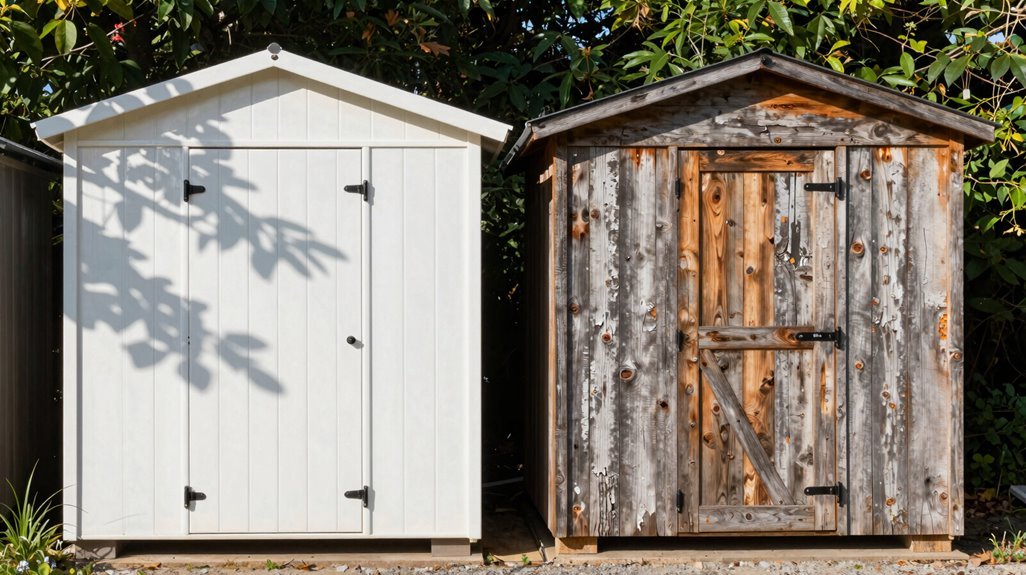
Why settle for mere storage when your shed could become a creative sanctuary? I’ve transformed both resin and wood structures into workshops, and each demands different compromises.
1. Resin Sheds: Plug-and-Play Convenience
Resin arrives with built-in ventilation, shelves, and racks; integrated features saving setup time. I appreciate the low maintenance and rot resistance, though panel cracks or wind-shifting limit load-bearing capacity for heavy equipment. Major damage requires full panel replacement.
2. Wood Sheds: Customizable Foundation
Wood’s strong framing supports lofts, heavy machinery, and iterative upgrades: insulation, wiring, finishes. I expand dimensions, reinforce wind stability through proper construction, and modify layouts as skills grow. Durability emerges through active stewardship, not factory specifications.
Choosing between resin’s convenience and wood’s evolutionary potential depends on your commitment to craft.
Which Shed Looks Better in Your Backyard?
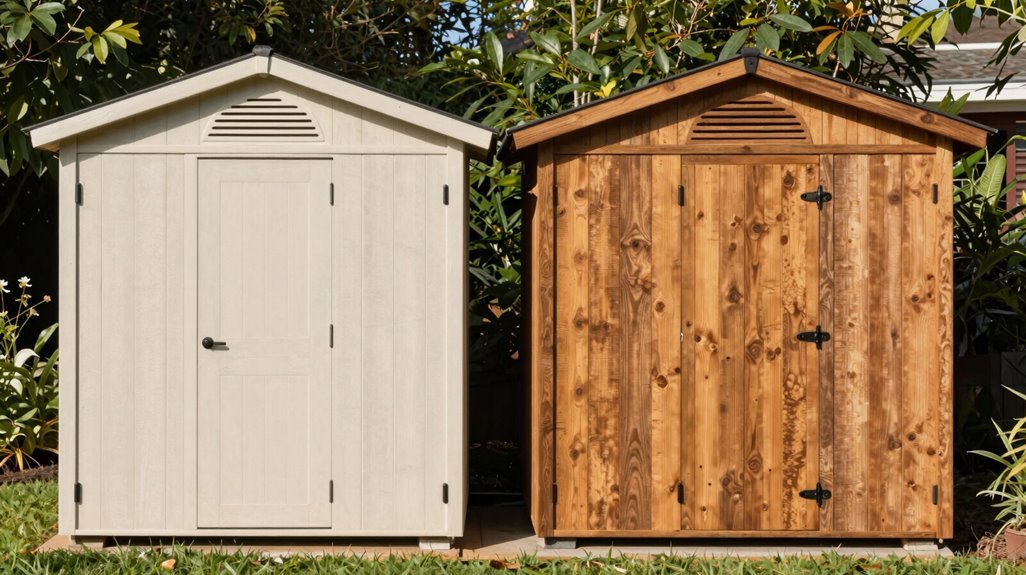
How does a structure reshape the entire character of your outdoor space? I’m convinced that choosing between Resin and wood comes down to the aesthetics you want defining your sanctuary.
- Traditional warmth: Wood sheds anchor cottage gardens and colonial landscapes with authentic grain patterns you can’t manufacture.
- Modern minimalism: Resin delivers clean lines and contemporary profiles, perfect for sleek, urban backyards where clutter feels criminal.
- Color evolution: Wood accepts stain transformations seasonally; Resin locks in its finish, for better or worse.
- Neighborhood harmony: I match wood to historic districts and Resin to planned communities with HOA restrictions.
- Patina versus permanence: Wood ages gracefully with maintenance; Resin stays frozen in time, resisting weather’s storytelling.
Your shed isn’t storage, it’s the backdrop to gatherings, the frame for your garden’s portrait.
Resin or Wood: Which Shed Matches Your Situation?

Where exactly does your shed need to perform, because I’ve learned that matching material to circumstance matters more than falling for surface appeal. Resin sheds suit my portfolio clients seeking rapid deployment and minimal maintenance in temperate zones, while Wood sheds reward those investing in permanence and bespoke architectural character.
I’ve anchored resin units in coastal Carolina and framed timber structures in Vermont’s freeze-thaw cycles: each choice reflecting priorities, not prestige.
| Your Priority | Resin Sheds | Wood Sheds |
|---|---|---|
| Maintenance tolerance | Minimal; rinse occasionally | Regular sealing, staining required |
| Climate demands | Moisture-resistant, UV concerns | Adaptable with proper treatment |
| Timeline | Immediate need, 5–7 years | Generational investment, 20–30 years |
| Customization | Modular accessories | Full architectural freedom |
Choose resin for mobility and affordability; select wood when your project demands legacy.