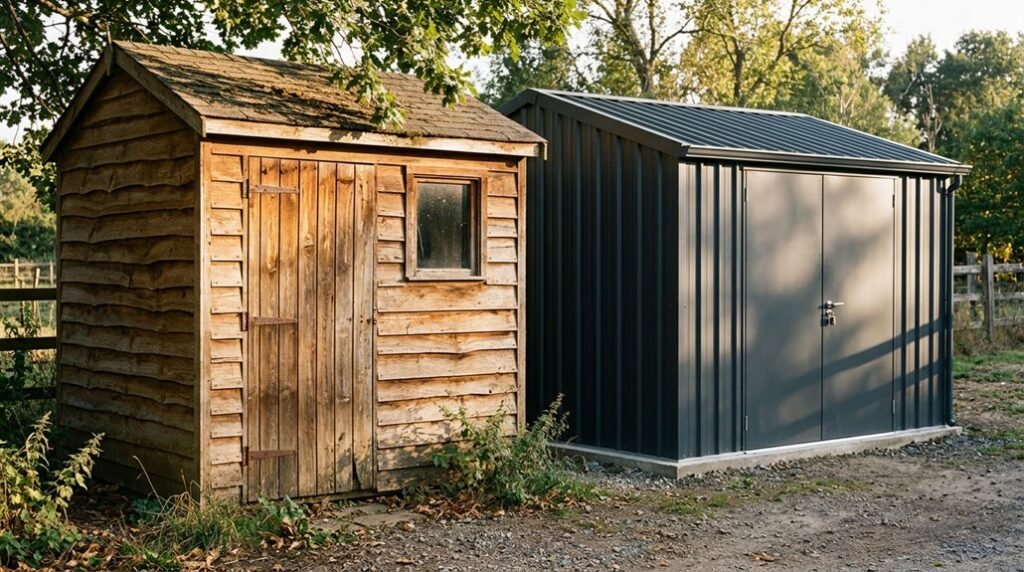
I’ve stood in both: a cedar-clad studio in Oregon’s damp Willamette Valley, its joinery swelling with winter rain, and a galvanized steel workshop baking under Arizona’s Sonoran sun, ribbed panels pinging at noon.
Each structure served its purpose, yet demanded entirely different relationships from me as owner.
The choice between wood and metal isn’t merely aesthetic or budgetary; it’s a commitment to maintenance rhythms, thermal behavior, and how you’ll actually use the space. Five critical distinctions separate these materials, and understanding them prevents costly misalignment between expectation and reality.
Wood vs. Metal Storage Sheds: 5 Deciding Factors
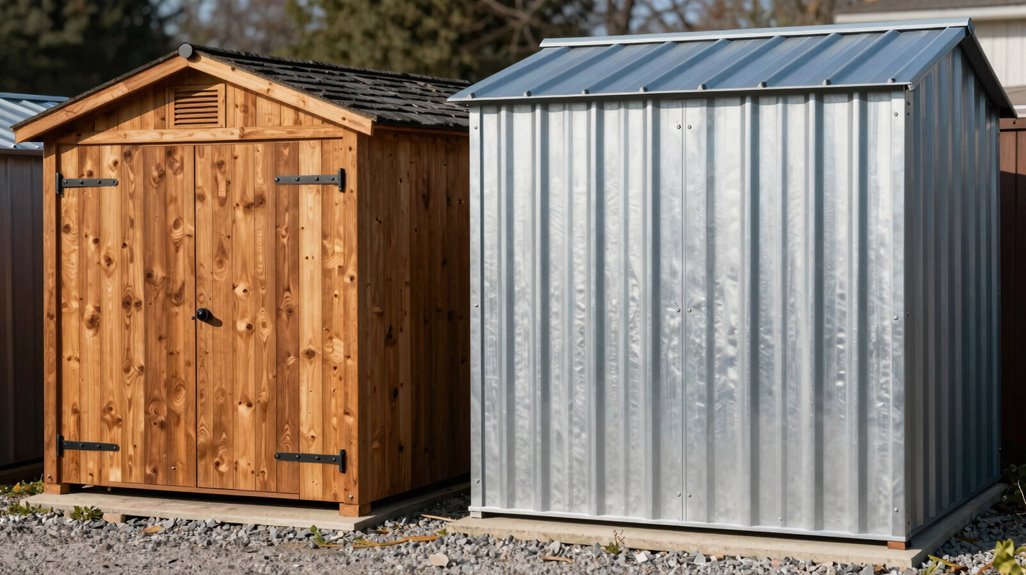
When I’m weighing options for my property’s storage solution, I find that choosing between wood and metal sheds demands careful consideration of how each material aligns with my priorities: durability, maintenance tolerance, aesthetic vision, budget parameters, and local climate realities.
- Metal wins on durability. Galvanized steel resists rot, termites, and mold, delivering 25+ years of service with proper anchoring. Wood, despite its charm, fights a losing battle against moisture and pests without vigilant care. I’ve seen pine framing succumb to powder post beetles in humid coastal Carolina within three seasons.
- Maintenance demands diverge sharply. My metal shed needs biannual cleaning and rust inspection, perhaps two hours yearly. Wood demands sealing, painting, and pest monitoring. Skip a maintenance cycle, and you’re chasing repairs.
We belong with materials matching our commitment capacity.
Upfront Cost: Which Material Saves You Money?
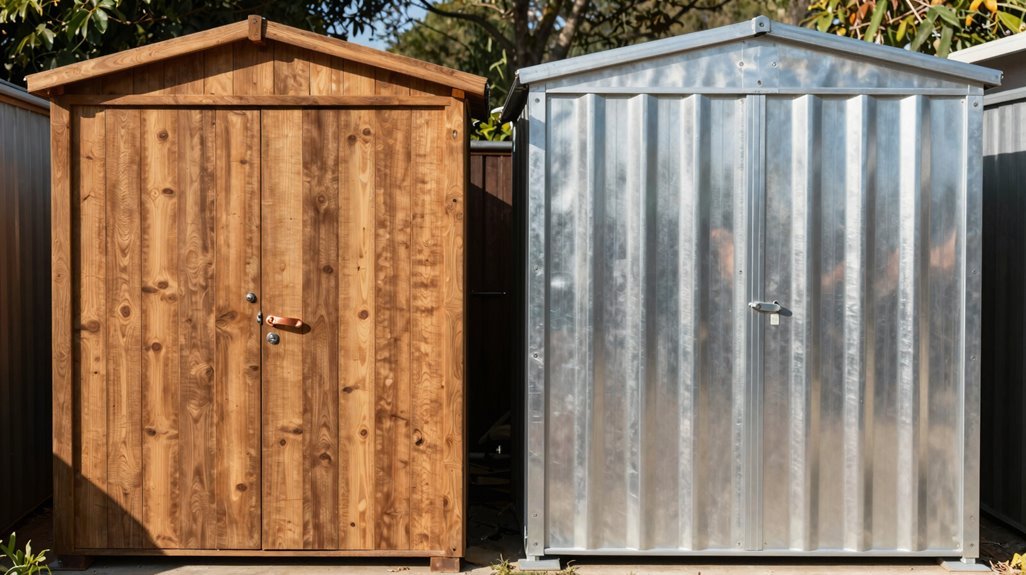
When I’m weighing my options for a backyard structure, I start by looking at the initial purchase price. Metal sheds typically run lighter on my wallet thanks to streamlined manufacturing and reduced labor demands. Yet I can’t stop there, because long-term ownership costs tell a different story: wood demands ongoing investment in staining, sealing, and pest management that quietly erodes any early savings.
Before I commit, I’m examining hidden expense factors too. Site preparation, foundation requirements, and local permitting fees shift the math regardless of which material I choose.
Initial Purchase Price
At the outset of any shed project, I’m weighing my budget against my vision, and metal usually wins on price. The initial price gap hits immediately: metal sheds run cheaper because manufacturers stamp steel panels faster than carpenters frame dimensional lumber. My budget stretches further with prefabricated metal kits requiring minimal labor hours, while wood demands skilled joinery and heavier structural members.
You’ll rarely spot quality wood sheds under $1,000, yet metal options populate that entry-level cost tier comfortably. Factor in immediate finishing; wood needs staining or painting before weather strikes, adding to that first invoice, and the arithmetic favors steel.
| Shed Type | Typical Initial Cost | Best For |
|---|---|---|
| Metal | $300–$800 | Tight budgets, quick installation |
| Wood | $1,200–$3,500+ | Custom aesthetics, permanent structures |
| Hybrid | $800–$1,500 | Balancing cost with visual warmth |
Long-Term Ownership Costs
The sticker price only tells part of the story. I’ve learned that what matters is what I spend over decades, not just the day I haul materials home. When I’m calculating true ownership expense, I’m tracking long-term costs beyond that initial receipt.
- Metal wins upfront. Lower material costs mean I’m spending less initially, keeping my budget flexible for other projects.
- Wood demands commitment. Annual staining, sealing, and pest prevention add maintenance that drains my weekends and wallet.
- Labor stacks up. Wood’s intricate construction means I’m either hiring help or sacrificing Saturdays.
- Metal slows value depreciation. Its durability preserves functionality without constant investment.
- Wood’s hidden potential. Customization and interior versatility can boost property value, offsetting higher expenses for homeowners prioritizing longevity over immediate savings.
I’d choose based on whether I’m building for tomorrow’s resale or today’s simplicity.
Hidden Expense Factors
Looking beyond the price tag, I’ve learned that true savings emerge from what I don’t see at checkout, those lurking costs that reshape my budget months or years down the line.
| Factor | Metal Shed | Wood Shed |
|---|---|---|
| Upfront Cost | Lower | Higher |
| Maintenance | Minimal; occasional rust treatment | Regular; staining, painting, sealing |
| Longevity | 20+ years with care | 15-20 years with diligent upkeep |
| Total Ownership | Favors budget-conscious buyers | Higher investment, potential property value boost |
Metal wins on immediate affordability, but I’ve discovered the real math happens in decades of ownership. Wood demands my attention seasonally: scraping, sealing, weatherproofing, each task adding labor and material costs. Metal’s galvanized resilience frees my weekends, trading aesthetic warmth for structural pragmatism.
For longevity without drain, metal aligns with my practical priorities; wood rewards those valuing craftsmanship over convenience.
Maintenance Reality: Steel’s Hands-Off Advantage
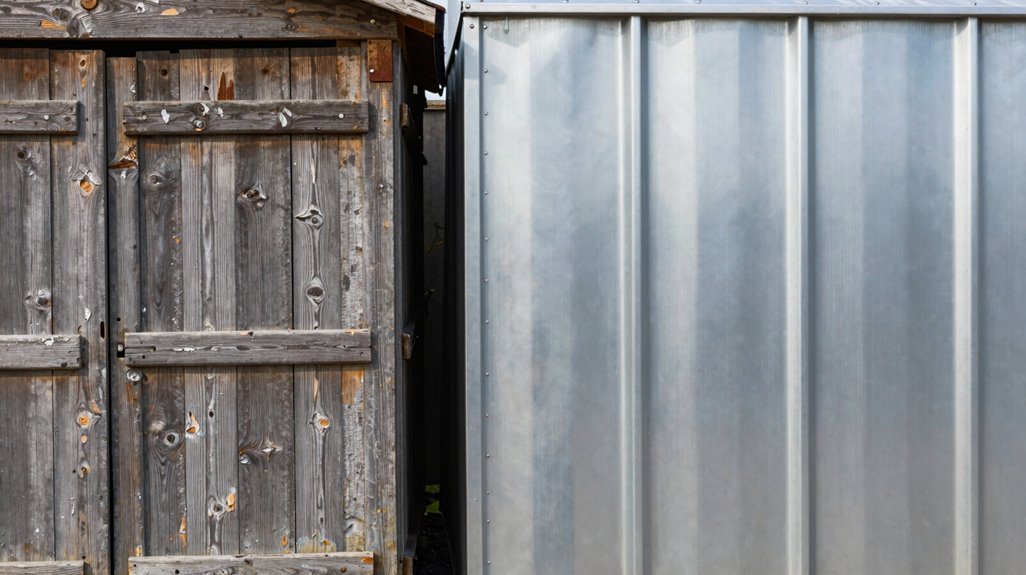
Skip the weekend scraping and repainting, steel sheds deliver a maintenance profile that respects both your time and your property’s long-term integrity. I’ve learned that choosing steel means joining a community of homeowners who value practical solutions over perpetual upkeep.
Your maintenance routine becomes refreshingly simple:
- Occasional rinsing, a garden hose removes debris seasonally, typically requiring 30 minutes annually
- Rust prevention checks, inspect seams and fasteners biannually, particularly after harsh winters in coastal Maine or rainy Pacific Northwest regions
- Natural rot immunity, steel eliminates the fungal decay and termite damage endemic to wooden structures in humid Southern climates
- Minimal recoating needs, factory finishes last decades, unlike wood’s 3–5 year repainting cycle
- Structural anchoring verification, reinforced foundations guarantee durability against 90 mph winds and heavy snow loads common in Rocky Mountain elevations
Design Freedom: Wood’s Customization Edge
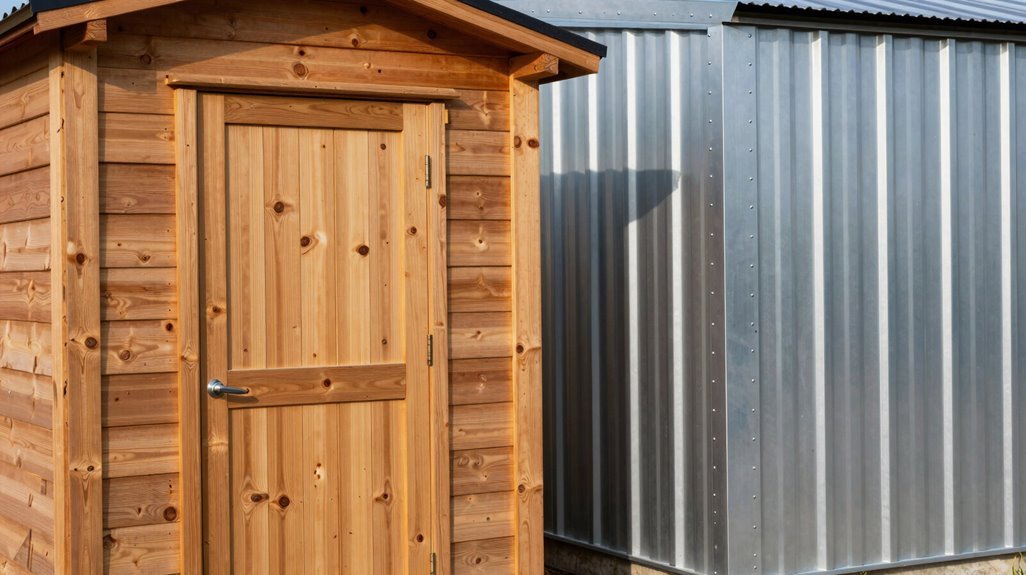
When I’m planning a shed that truly feels like an extension of my home, wood construction opens possibilities metal simply can’t match. Built-in flexibility means I can spec custom window placements, reconfigure interior partitions, or add a lofted sleeping area without fighting rigid panel systems.
Structural modifications come naturally with lumber framing, letting me run conduit for workshop outlets, sister joists for heavier loads, or even bump out a bay window later if my needs evolve. From board-and-batten siding stained in weathered gray to crisp white trim with copper flashing, the finish options turn a basic outbuilding into a curated architectural statement, though I’ll budget for the ongoing upkeep that preserves these choices.
Built-In Flexibility
Why settle for a box that merely stores your gear when you could craft a space that actually works for you? I’ve found that wood sheds deliver unmatched flexibility; you’re not locked into someone else’s blueprint.
Interior Adaptability — Adding shelves, hooks, or electrical runs feels intuitive, not invasive.
Aesthetic Harmony — Matching your home’s palette with any stain or paint creates visual continuity.
Complex Layouts — Lofts and integrated workspaces emerge without kit-imposed constraints.
Personal Expression — Each choice reflects your priorities, not a factory default.
Ongoing Vigilance — This freedom demands commitment: sealing, staining, and pest prevention preserve your investment.
True customization means building something that belongs to you, functionally and visually.
Structural Modifications
How far can you push a structure before it stops being a storage unit and becomes something else entirely? With wood, I’ve found the boundary barely exists.
1. Interior Adaptability
Wood framing accepts shelves, lofts, and workspaces without engineered brackets, simply sistering joists where needed. I’ve wired lighting through stud bays in Ohio backyards, creating studios that feel like home extensions.
2. Dimensional Freedom
Unlike metal’s fixed modules, wood permits on-site adjustments: extending eaves, raising plate heights, reconfiguring door placements. In coastal Carolina, I’ve seen sheds morph into pool houses through gradual modifications.
3. Exterior Integration
Window casings, flower boxes, trim profiles; wood accepts these cosmetic additions organically. The material wants to belong to your property’s architectural conversation.
This customization demands patience. Structural modifications with wood require carpentry skills and longer timelines than metal’s bolt-together efficiency. But for those seeking spaces that truly fit their lives, wood offers unmatched design freedom.
Finish Options
Structural modifications reshape how a shed functions, but finish options determine how it feels, and wood dominates this territory without contest. Metal sheds offer limited paintable surfaces and industrial aesthetics that rarely complement residential architecture, leaving you stranded in utilitarian sameness.
Meanwhile, wood finish options open genuine personalization through exterior coatings that protect and transform.
Consider wood’s advantages:
- Infinite color palettes using premium paints from Sherwin-Williams or Benjamin Moore
- Stainable surfaces revealing natural grain patterns and rustic warmth
- LP SmartSide siding mimicking cottage aesthetics with textured authenticity
- Custom tinting that matches your home’s existing trim and roofing
- Interior adaptability supporting backyard offices or creative studios
You’re not merely buying storage, you’re claiming space that reflects your identity. Wood finish options deliver that belonging.
Climate Performance: Weather Resistance Compared
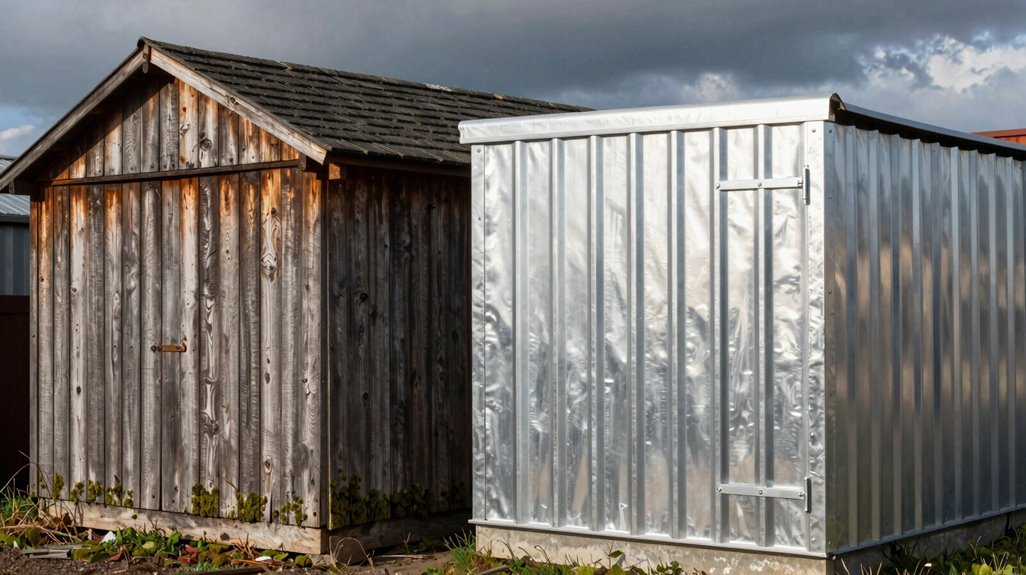
The climate where I’m building my shed will shape everything from material longevity to daily usability.
Moisture Defense
Metal sheds resist rot, termites, and mold more effectively than wood in wet or humid climates: coastal Florida, Pacific Northwest. This offers structural integrity without chemical treatments. Wood demands vigilant sealing.
Thermal Behavior
Metal heats rapidly in summer and freezes in winter. Wood provides more consistent temperatures naturally. In Arizona’s desert extremes, uninsulated metal becomes unusable midday.
Condensation Control
Humid environments produce moisture accumulation in metal sheds, risking stored goods. Wood, with proper ventilation such as soffit vents and ridge caps, manages atmospheric moisture differently.
Fire Resistance
Wildfire-prone California and Colorado favor metal’s non-combustible profile. Wood requires intumescent coatings or ignition-resistant siding to achieve comparable protection.
Your regional conditions, rainfall patterns, temperature swings, and fire risk, determine which material belongs in your landscape.
Year-Round Comfort: Insulation and Temperature Control
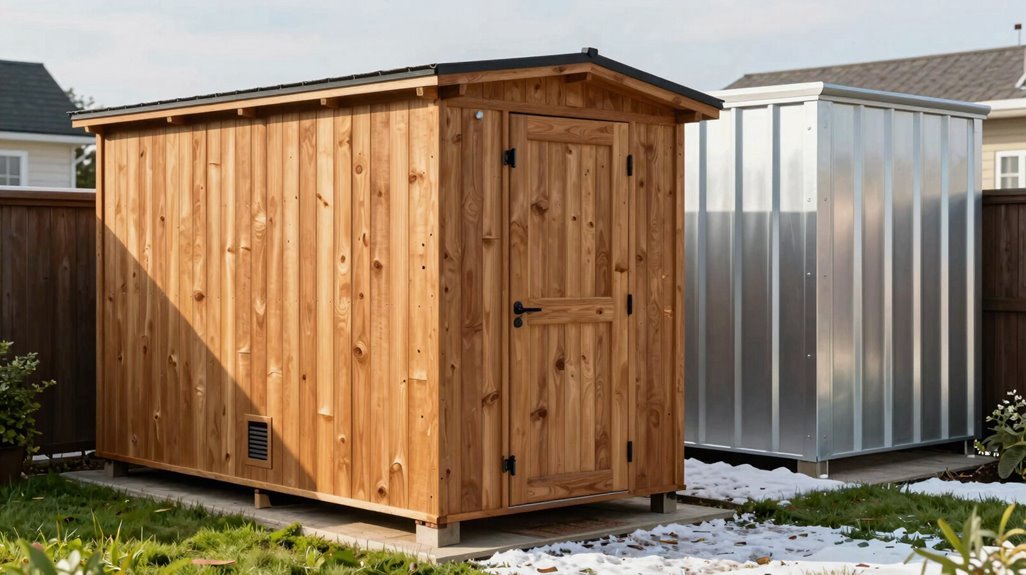
Where comfort matters most, my workshop, studio, or retreat space, temperature control separates usable square footage from seasonal storage. I’ve learned that year-round comfort hinges on how each material handles insulation and temperature regulation.
Wood’s cellular structure provides natural insulation, keeping interiors 10-15 degrees cooler in summer, warmer in winter without modification. Metal conducts thermal energy aggressively, transforming sheds into solar ovens or freezers depending on season. Condensation plagues uninsulated metal in humid climates, damaging tools, electronics, and cherished belongings.
Achieving equivalent temperature regulation in metal demands retrofitting: rigid foam, vapor barriers, climate control systems. Wood establishes baseline livability faster; framing accepts batts or spray foam seamlessly for four-season habitation.
For my sanctuary spaces, wood’s inherent thermal performance delivers belonging without compromise.
DIY Build: Which Shed Is Easier to Assemble?
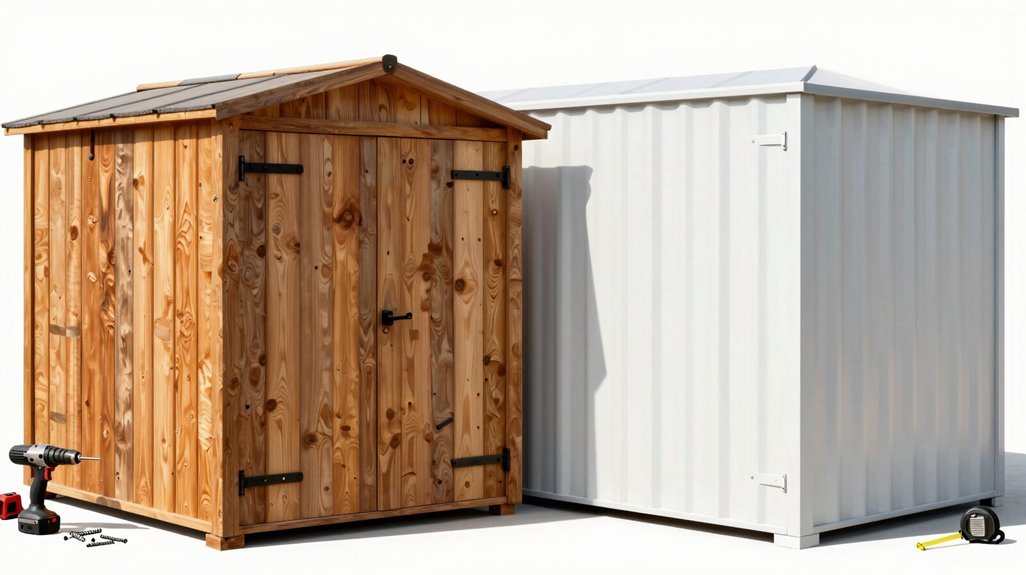
1. Pre-Fabricated Efficiency
How quickly can I transform my backyard into organized storage? With metal sheds, I’m looking at remarkably shorter assembly windows; pre-cut panels and standardized hardware arrive ready to interlock. These modular wall kits eliminate on-site cutting, compressing build time into a single weekend for most standard sizes.
2. Construction Complexity
Wood demands more from me: framing, panel alignment, sealing treatments. Each board requires fitting, measuring, adjusting; processes that stretch across multiple days even for experienced DIYers seeking that handcrafted aesthetic.
3. Scalability Advantage
Metal’s lightweight, bolt-together extensions let me expand storage capacity later without reconstructing foundations; a flexibility most wooden systems can’t match without significant structural re-engineering.
For speed and simplicity, metal wins my weekend. For customization, I’ll accept wood’s labor investment.
Lifespan Expectations: 10 Years or 30?
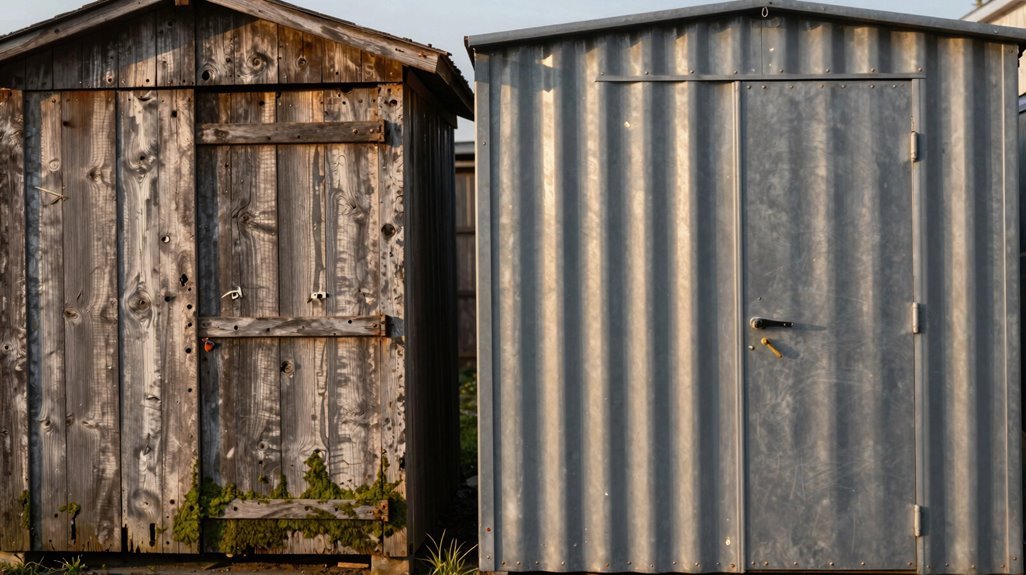
Once I’ve secured my tools and stepped back from the assembly process, I’m forced to confront a harder question: how long will my investment actually stand? The lifespan gap between wood and metal sheds is stark, and it shapes how we plan our outdoor spaces.
Metal longevity: Properly built steel structures often exceed 25 years, shrugging off rot and termites that plague organic materials.
Wood potential: Decades of service are possible, but only through relentless sealing, painting, and pest vigilance.
Climate advantage: In humid coastal regions, metal’s corrosion resistance (with proper coating) outperforms wood’s vulnerability.
Maintenance math: Metal reduces upkeep frequency; wood demands continuous structural attention.
Reality check: Neglected wood sheds deteriorate within 10 years—metal endures, rewarding those who value lasting craftsmanship.
Choose your timeline wisely.
Security: Break-In Resistance Compared
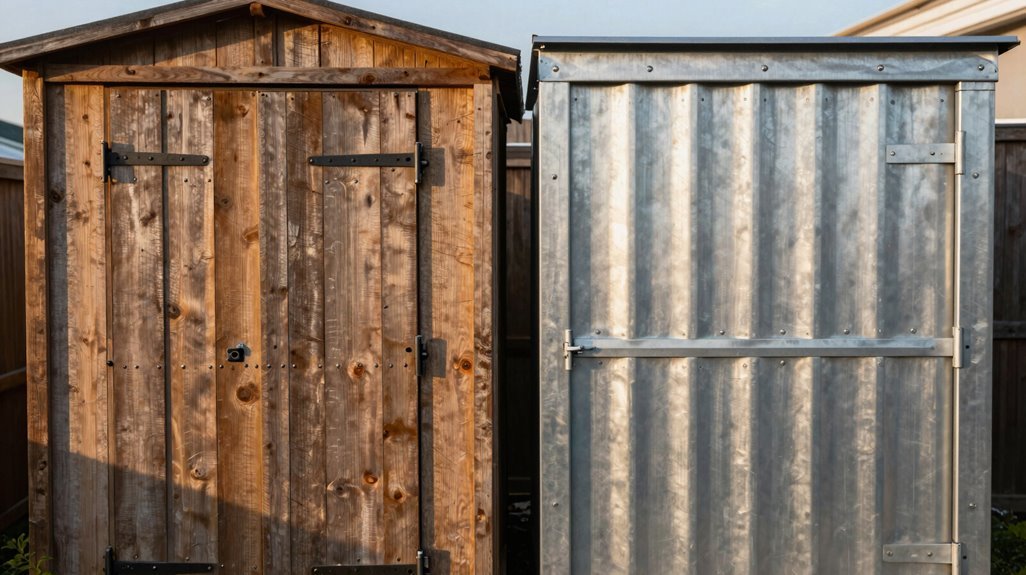
When I’m evaluating shed security, I look first at how lock strength, door vulnerability, and window placement create a complete defensive envelope. Metal’s rigid panels and pre-engineered jambs resist prying better than hollow wood, though warping wooden doors and poorly reinforced frames can compromise either material.
I’ve noticed that metal sheds typically ship with fewer entry points and more standardized security features, while wood structures demand careful hardware selection and ongoing maintenance to prevent gaps from developing at the threshold.
Ultimately, I’m convinced that break-in resistance hinges less on whether you choose corrugated steel or cedar siding, and more on installing grade-1 deadbolts, tamper-proof hasps, and anchoring the entire structure to a concrete slab.
Lock Strength Comparison
How does a shed’s material shape its ability to withstand forced entry? I’ve found that lock strength and security depend heavily on what surrounds the hardware itself.
- Reinforced framing, Metal sheds boast internal steel bracing that resists flexing, delivering superior anti-pry protection where bolts seat into the structure.
- Pre-installed deadbolts, Many metal kits arrive with heavy-duty locking mechanisms already integrated, saving you upgrade headaches.
- Rot vulnerability, Wood sheds face invisible enemies; moisture creeping into grain compromises security from within, weakening anchor points you can’t see.
- Warping risks, Humidity swells lumber, misaligning strike plates and reducing lock effectiveness when you need it most.
- Hardware dependency, Your wooden structure’s safety hinges on maintenance discipline, sealing, staining, inspecting, where metal forgives neglect.
Choose metal for set-it-and-forget-it peace of mind, or commit to wood’s demanding care ritual.
Door Vulnerability Factors
Lock strength tells only part of the story, the door itself remains your shed’s most exposed surface, and I’ve learned that material choice fundamentally shapes how intruders approach it. Metal sheds typically ship with reinforced hardware and rigid steel framing that resists prying, while wooden structures often rely on hollow-core doors and standard hinges you can defeat with basic tools.
I’ve watched how swollen timber creates latch gaps that compromise door security, whereas steel maintains dimensional stability through seasons. For comparable intrusion resistance, wood demands aftermarket upgrades, deadbolts, security hasps, reinforced jambs, that metal sheds include from the factory. We all want our belongings protected without constant worry; choosing the right material gets us there faster.
| Feature | Metal Shed | Wood Shed |
|---|---|---|
| Door construction | Solid steel panel, welded frame | Hollow or solid wood, screw-mounted |
| Hinge security | Heavy-gauge, tamper-resistant | Standard, easily pried |
| Hardware compatibility | Built for reinforced hardware | Requires aftermarket drilling |
| Weather impact on security | Minimal, maintains fit | Warping creates gaps |
| Base intrusion resistance | High, inherent rigidity | Moderate, needs upgrades |
Window Security Risks
Where windows puncture a shed’s envelope, I’ve found that security calculations shift dramatically; glass transforms from amenity to liability regardless of what frames it.
When you’re weighing window security in your storage sanctuary, consider these vulnerabilities:
Metal sheds with solid panels present fewer natural entry points, though windowed designs introduce exploitable glass or small openings attackers target. Wood structures often arrive with multiple pre-cut openings and traditional hinged doors: visible hardware that demands reinforced doors and vigilant maintenance.
Vinyl or metal-framed windows pry open without laminated glazing security; wood frames flex under force, creating compromising gaps. Shaded or frosted glass with locks helps, yet inexpensive acrylic inserts in both materials crack or pry loose under pressure.
Strategic reinforcement, metal bars, security films, laminated glass, robust latches, reduces risk substantially, with wood benefiting most from interior deadbolts and solid-core upgrades
Fire Safety: Wood vs. Metal Performance
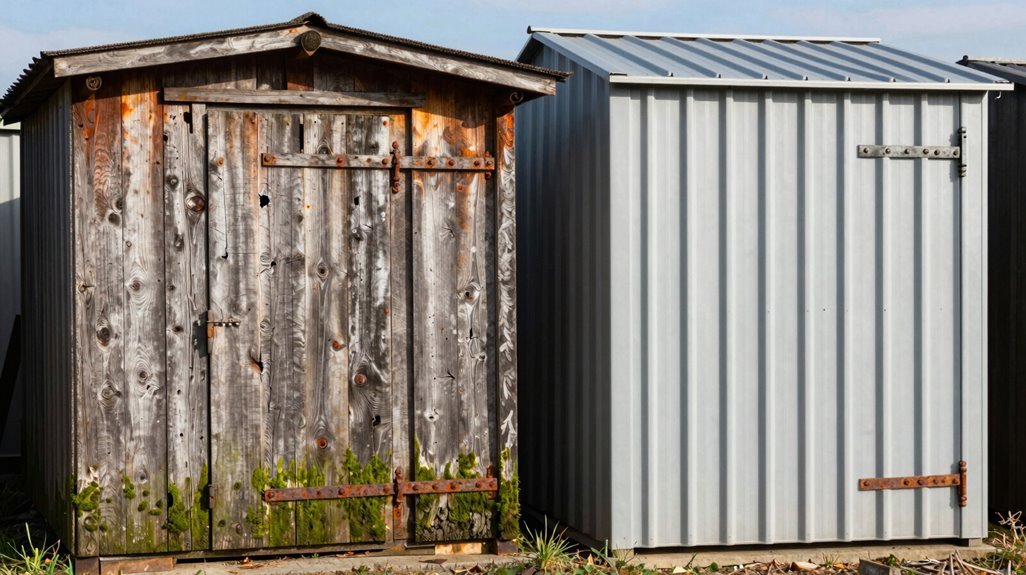
When I’m weighing my options for backyard storage, fire safety isn’t always the first consideration, but it absolutely should be. I’ve learned that wood sheds carry higher ignition risk simply because wood contains oxygen and burns readily, while galvanized steel structures remain non-combustible under extreme heat. This matters when I’m storing fuel cans, chemical treatments, or power tools with lithium batteries.
| What I Store | Wood Shed Risk | Metal Shed Advantage |
|---|---|---|
| Gasoline & propane | High vulnerability, embers ignite fast | Non-combustible walls contain spills |
| Power tools & batteries | Thermal runaway threatens structure | Heat dissipates; no fuel source |
| Family heirlooms | Irreplaceable loss in minutes | Protected shell buys precious time |
In wildfire-prone regions, California’s chaparral zones, Colorado’s front range, metal construction delivers peace of mind I can’t replicate with treated lumber. For fire safety that protects what I’ve built, steel’s performance justifies the investment.
Property Value: Which Shed Pays Off?
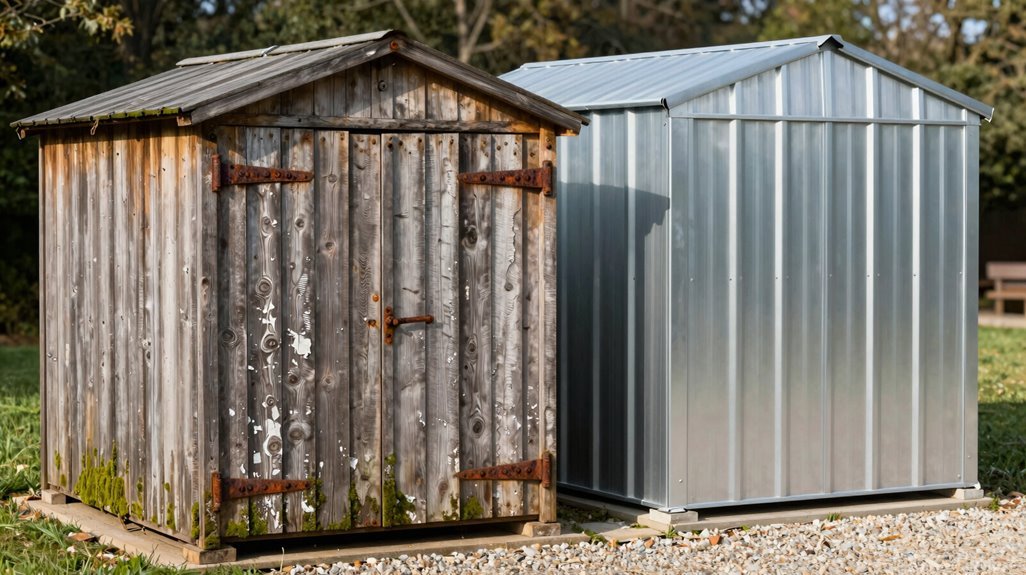
When I’m weighing whether a shed actually pays off, I look at three things that hit your wallet differently over time: visual impact on the property exterior, resale value trends, and longevity investment returns. Wood’s custom millwork and architectural detailing can turn a backyard into a curated outdoor room, potentially boosting appraisal values in markets where buyers expect that cottage aesthetic.
Metal, meanwhile, offers a pragmatic ROI through decades of structural integrity with virtually zero capital improvement cycles, preserving value without draining your maintenance budget.
Curb Appeal Impact
- Curb appeal matters when you’re building something meant to last, your shed should feel like it belongs.
- Natural integration — Wood sheds blend with landscaping, boosting property appearance through organic aesthetics that metal rarely achieves
- Color freedom — I can match any exterior palette, ensuring cohesive visual value across the property
- Industrial limitations — Metal’s utilitarian look often feels imposed rather than invited, diminishing perceived worth
- Maintenance dependency — Well-sealed wood maintains its charm; neglected boards quickly erode that investment
- Market positioning — In upscale neighborhoods, refined wood construction with custom trim signals belonging among discerning homeowners
Your choice shapes first impressions, make it count.
Resale Value Trends
Where does your investment actually land when the for-sale sign goes up? I’ve found that wood sheds often tip the scales in your favor: buyers gravitate toward their bespoke craftsmanship, envisioning potting benches or studio conversions that metal simply can’t match. That customization potential translates directly to resale value, especially in neighborhoods where architectural cohesion matters.
Yet I’m not discounting metal’s appeal. Its durability speaks to practical buyers seeking low-effort solutions; families prioritizing function over form, investors eyeing rental properties. In coastal zones, where humidity warps timber, steel’s resilience actually preserves condition and value.
Here’s my take: wood sheds reward the hands-on homeowner who maintains them; metal rewards the set-it-and-forget-it mindset. Neither choice excludes you from the community of savvy sellers; just know which tribe you’re buying into, and plan accordingly.
Longevity Investment Returns
Resale value tells only part of the story. I’m more interested in how these structures perform across decades of ownership, and what that means for your bottom line. When weighing longevity against upfront costs, you’ll want to consider where your investment actually pays dividends.
- Metal’s 25+ year lifespan delivers durability without the rot, termites, or mold that plague wooden alternatives in humid climates
- Wood’s aesthetic premium commands higher property values through customization: think cupolas, window boxes, and complementary siding
- Maintenance math favors metal’s lower lifetime costs versus wood’s recurring sealing, staining, and repairs
- Curb appeal calculus rewards well-kept wood sheds in neighborhoods where architectural cohesion matters
- Climate considerations make metal’s reliability a smarter investment in wet regions where wood deteriorates faster
Your choice reflects what you value: enduring functionality or flexible refinement.
Eco-Footprint: The Sustainability Comparison
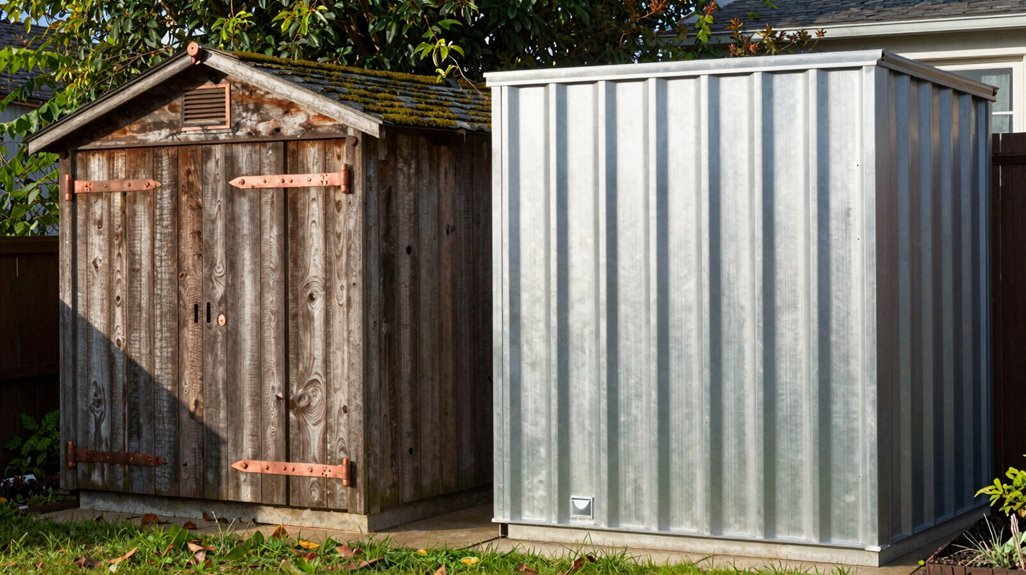
How do we weigh the true cost of sheltering our belongings against the cost to the planet? When comparing wood and metal sheds, sustainability reveals itself in layers: material sourcing, maintenance demands, and end-of-life destiny.
1. Embodied Energy at Birth
Wood carries the weight of forest harvesting and milling, its footprint swelling with transportation and processing, unless sourced from certified, local timber. Metal, born from ore and furnace, demands intense initial energy yet offers redemption through recyclability.
Wood bears the burden of harvest and distance; steel, though born of fire, finds second life in endless renewal.
2. The Maintenance Burden
I’ve watched wood surrender to rot and termites, demanding sealants, stains, and chemical defenses, each application adding environmental debt. Metal stands resilient, its coated surface resisting corrosion with minimal intervention, shrinking its ongoing footprint.
3. End-of-Life Legacy
Steel sheds dissolve back into industry, recycled endlessly. Wood returns to earth slowly, sometimes treated beyond composting. True sustainability hinges on our choices: certified lumber, recycled steel, and mindful maintenance rhythms.
Resin and Vinyl: Should You Consider Alternatives?
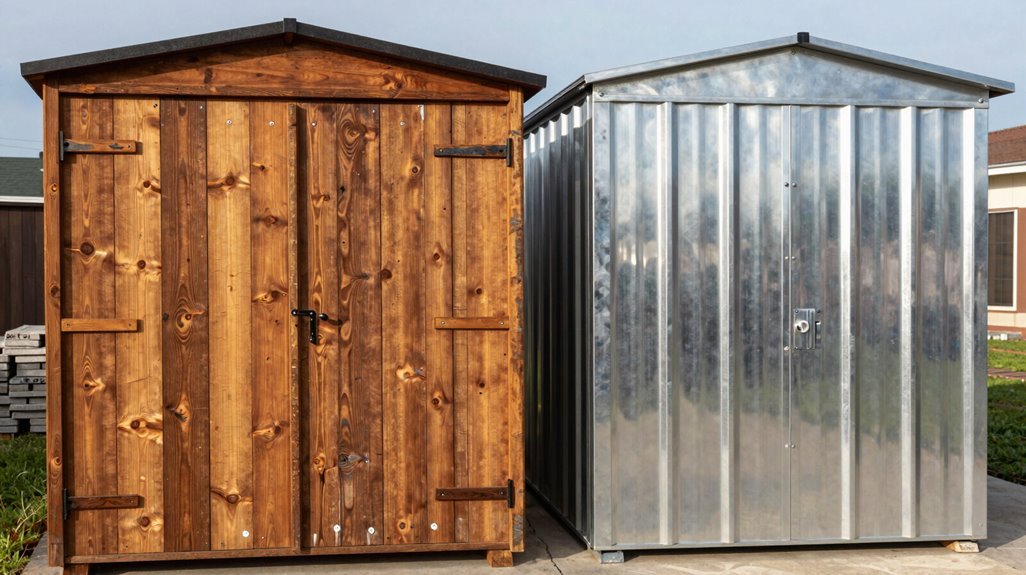
Why settle for traditional materials when modern polymers promise liberation from maintenance? I’ve watched resin vs metal debates reshape how we think about backyard storage, especially when durability meets our desire for effortless living.
Weatherproof resilience defines the resin advantage. Resin shrugs off UV damage, moisture, and pests without the maintenance wood demands; coastal humidity becomes irrelevant.
Built-in functionality separates these materials from conventional options. Integrated shelving, ventilation, and wood-grain aesthetics create instant utility without carpentry skills.
Vinyl offers specialized performance as a resin subtype. Superior UV resistance comes standard, though limited customization restricts heavy modification.
Retail accessibility removes purchase friction. Home Depot, Lowe’s, and Walmart stock Keter and similar brands: 100% recyclable, portable, and ready today.
Climate advantage matters most in challenging environments. In humid or coastal regions, synthetic construction outperforms organic materials where rot threatens structural integrity.
Quick Verdict: Choose Metal If
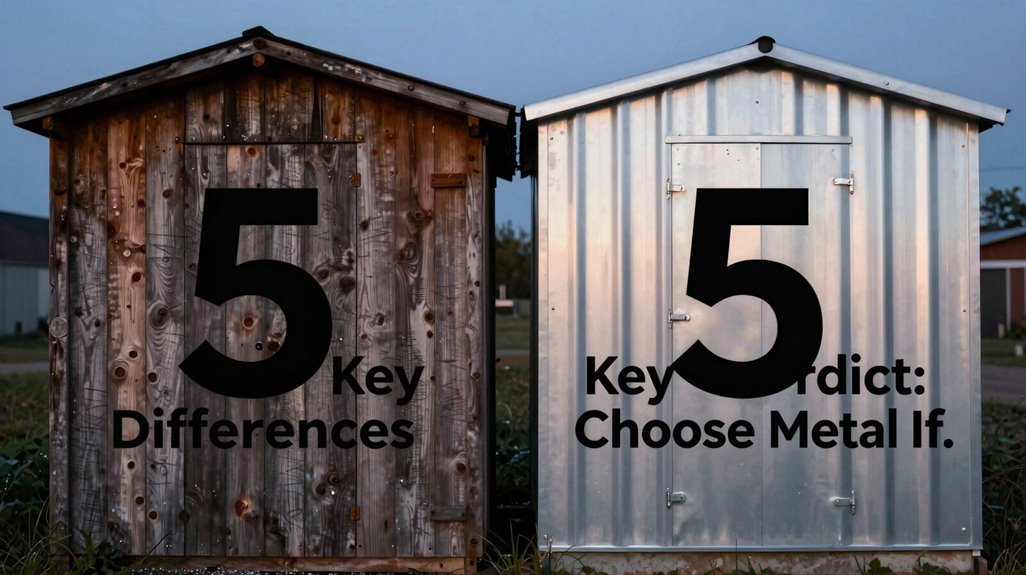
Yet resin’s polished surfaces and vinyl’s weatherproofing aren’t the final word in backyard storage. When I’m weighing metal against wood, I know exactly where I stand, and you might find yourself standing there too.
1. Budget matters most. Metal sheds cost less upfront, and I’m assembling mine in an afternoon with pre-fabricated kits; no contractor required.
2. I despise upkeep. Metal delivers near-zero maintenance; I’m not staining, sealing, or replacing rotted boards. That durability frees my weekends.
3. Heat and fire concern me. Metal stays cooler in scorching climates, Phoenix, anyone?, and won’t ignite near my gas cans.
4. I’m coastal or humid. With proper elevation and sealing, metal outlasts untreated wood against salt air and moisture.
Choose metal when you’d rather spend time *using* your shed than maintaining it.
Quick Verdict: Choose Wood If..
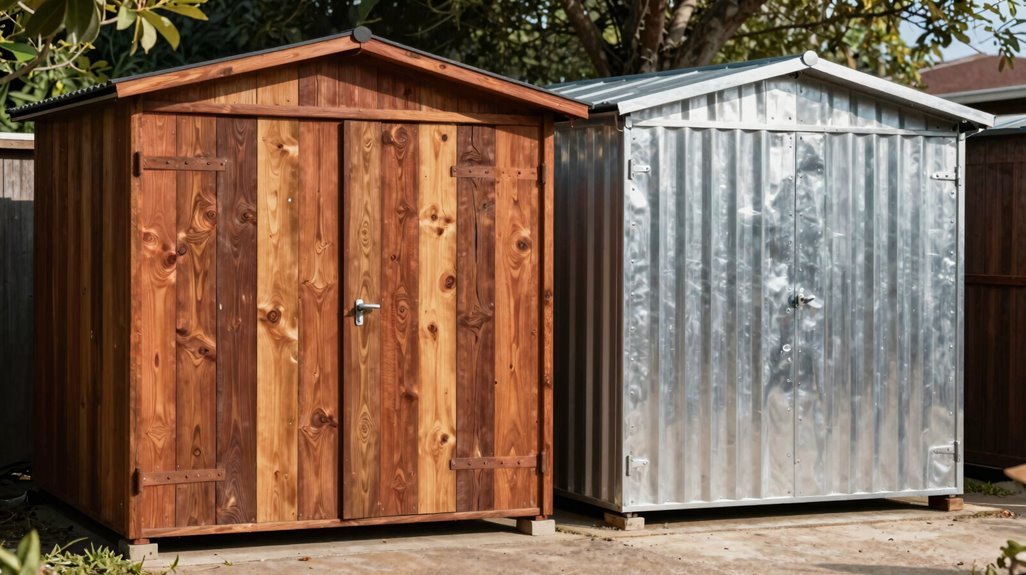
When my storage needs extend beyond mere containment, evolving into workshop, studio, or sanctuary, metal’s utilitarian box starts feeling like a constraint I’m unwilling to accept. I choose wood when personalization matters.
Wood adapts beautifully. I can reconfigure interiors, adding lofts, windows, or wiring, without fighting rigid panels. The natural insulation keeps my space habitable year-round, whether I’m potting seedlings in March or crafting in August’s heat.
Wood bends to your vision—reconfigure, insulate, inhabit. Your space evolves as freely as your ambitions demand.
Yes, maintenance demands commitment. I seal, stain, and monitor for pests knowing this preserves my investment’s integrity and warmth.
Consider wood if you seek:
- Customizable interiors for evolving workspace needs
- Superior insulation against temperature extremes
- Aesthetic harmony with your home’s architectural character
- Willingness to embrace ongoing maintenance routines
- Higher upfront investment for long-term livability
Join me in choosing substance that breathes with your ambitions.